
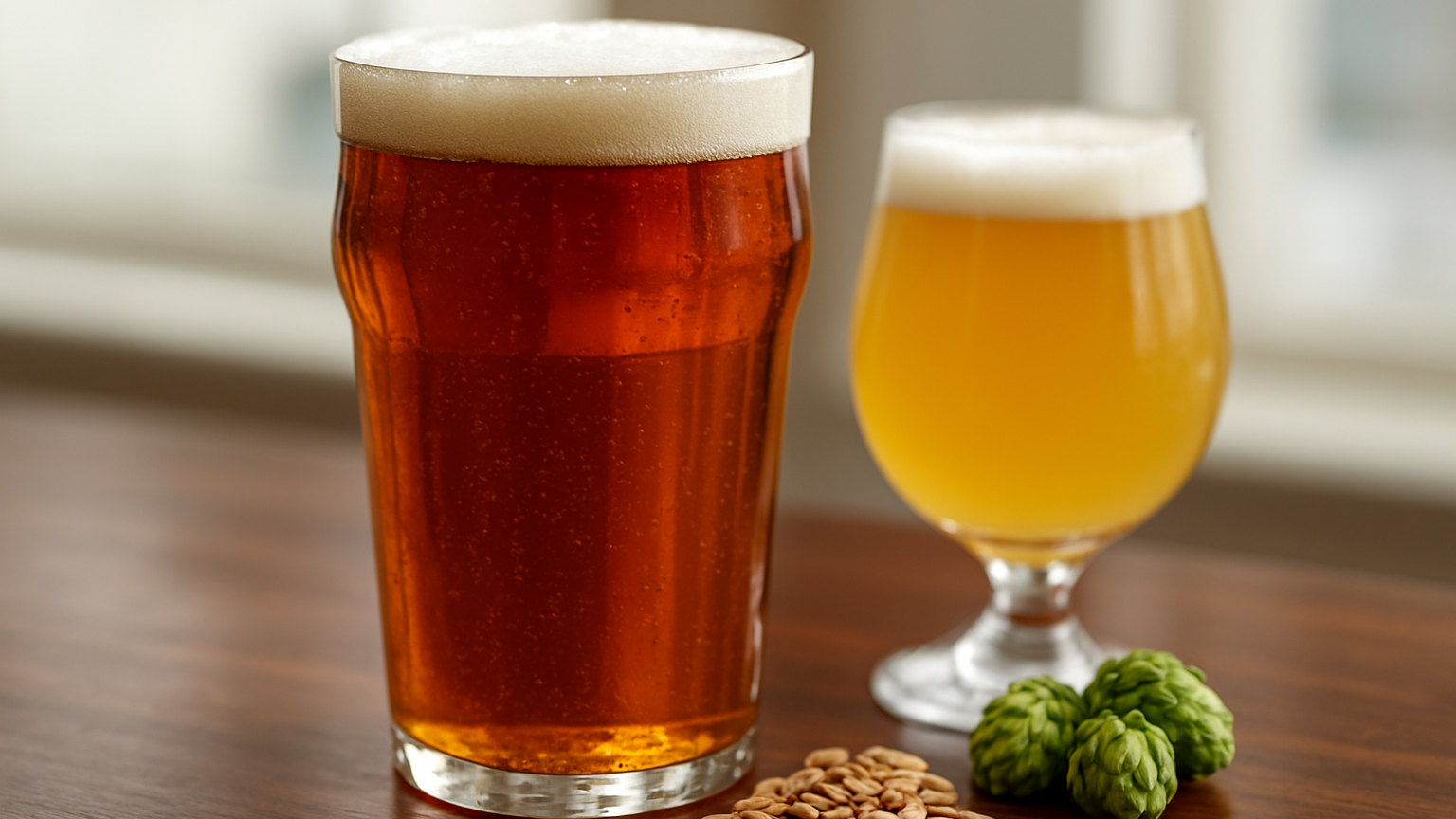
Bitter is the beer most associated with the British pub, and its name is one of the more misleading in drinking. A typical bitter is moderately hopped, malt-driven and gently balanced, and a modern IPA will be several times more bitter by any measurement.
The name came from a comparison that no longer exists in most people's experience, which is why it now sounds like a description of intensity rather than of contrast.
Where the name came from
Through the nineteenth century the everyday beer in most British pubs was mild, a lightly hopped, malt-forward beer usually drunk young. Alongside it, brewers produced pale ale, which was hopped more assertively and often aged longer.
Customers asked for the hoppier option by contrast with the sweeter one, calling for a glass of the bitter beer, and the shorthand stuck. Bitter was simply what drinkers called pale ale served on draught, and the two terms remain largely interchangeable in brewing terms.
The convention that developed is that a bottled version is a pale ale and the same beer on cask is a bitter, though plenty of exceptions exist.
What is actually in it
Pale malt forms the base, and crystal malt is the ingredient that defines the style. Crystal malt is produced by stewing wet grain before kilning, which converts starch to sugar inside the husk and caramelises it. It contributes the amber to copper colour, along with toffee, biscuit and nutty flavours and a residual sweetness that balances the hops.
English hop varieties supply the bitterness and the aroma, typically Fuggles and Goldings or their modern relatives, giving earthy, floral, herbal and marmalade notes rather than the citrus and pine of American varieties.
Ale yeast fermented warm adds fruit character, and the classic English strains contribute a distinct orange marmalade or stone fruit quality that is part of the style's identity.
Water chemistry matters more than most drinkers realise. Burton upon Trent's water is exceptionally high in sulphate, which accentuates hop bitterness and gives a dry, crisp finish and a faint sulphur note that brewers call the Burton snatch. Breweries elsewhere routinely add gypsum to imitate it, a practice known as Burtonisation.
The strength tiers
Bitter is generally divided into three bands, though the boundaries are conventional rather than legal.
Ordinary bitter sits at roughly three and a half to four per cent and is the classic session beer, designed for drinking several of over an evening. Best bitter runs from about four to four and a half. Strong bitter, sometimes called premium or ESB, sits above that, typically up to about five and a half.
The words best and premium indicate strength rather than quality, which surprises people. A brewery's ordinary bitter may well be its finest beer.
Why it tastes lighter than the name suggests
Measured bitterness in a typical British bitter falls somewhere in the twenties to thirties on the international scale. A modern IPA may be two or three times that, and the perception gap is wider still because IPA hopping is designed to be assertive while bitter hopping is designed to balance.
Crystal malt sweetness also offsets the bitterness directly, so the finished beer reads as rounded rather than sharp.
The result is a beer built for volume rather than impact, which is exactly what a pub session requires and exactly what makes it seem underwhelming to a drinker arriving from heavily hopped modern styles.
How to approach it
Judge it on balance and drinkability rather than on intensity. A good bitter is one you want a second of, and the qualities that produce that are subtle: a clean bitterness, a malt sweetness that does not cloy, and a finish that leaves you ready for the next mouthful.
Served properly at cellar temperature from a well kept cask, it is one of the most drinkable beers made anywhere. Served warm, flat or stale, it is dismal, which is why the style's reputation depends so heavily on the pub rather than the brewery.


