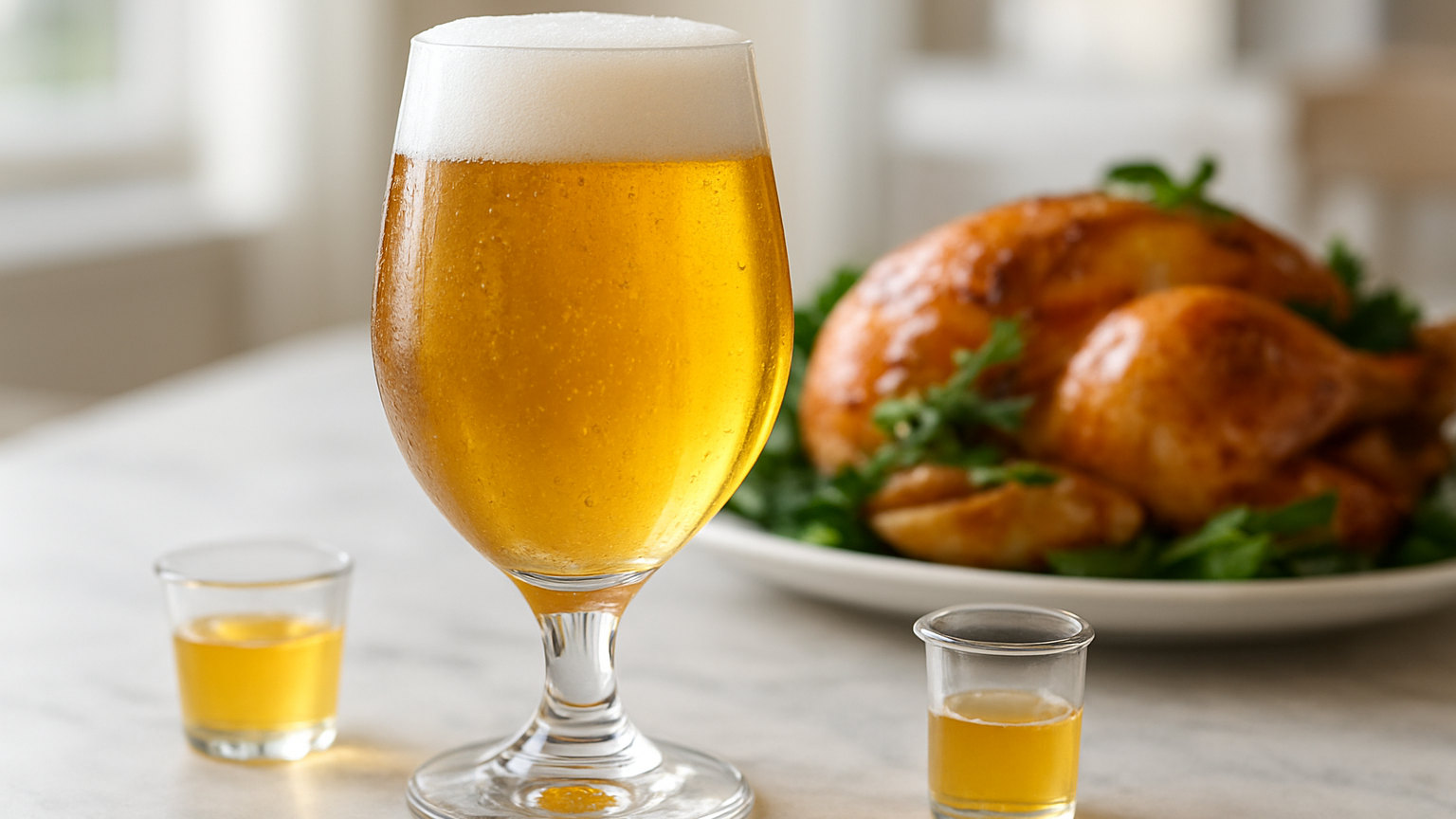
Ale is fermented warm with one family of yeast; lager is fermented cool with another and then stored cold for weeks. That single difference produces almost everything else people notice. Colour, strength and bitterness do not separate the two, despite the common belief that they do.
The actual difference
Ale yeast ferments at around eighteen to twenty two degrees and works throughout the vessel, gathering near the top. It is traditionally called top fermenting.
Lager yeast ferments at around eight to twelve degrees and settles towards the bottom, so it is called bottom fermenting. After fermentation the beer is conditioned cold, often for several weeks, which is the lagering the style is named after.
They are different species. Lager yeast is a hybrid that appears to have arisen when a cold-tolerant strain crossed with ordinary brewing yeast, which is why lager brewing emerged later than ale brewing.
Why temperature changes the flavour
Yeast does not only make alcohol. It produces esters and phenols, which are the compounds responsible for fruity and spicy aromas.
Warm fermentation produces a great many of them. This is why ales taste fruity, and why a German wheat beer tastes of banana and clove without anything of the sort being added.
Cool fermentation produces very few. A lager therefore tastes clean, and the malt and hops are exposed with nothing covering them.
The cold conditioning period compounds this, allowing rough compounds to settle out and producing a smoother, crisper beer.
What this means in the glass
Ale tends to be fruitier, fuller-bodied and more complex, and generally served warmer, at around eight to thirteen degrees depending on style.
Lager tends to be crisper, cleaner and more refreshing, and served colder, at around three to six degrees.
Neither is more sophisticated. A well made lager is arguably harder to brew than a well made ale, precisely because there is nowhere for a flaw to hide. Any off-flavour in a pilsner is immediately obvious, while a strong ale can carry a multitude of minor faults unnoticed.
The things that do not separate them
Colour. The most persistent misconception. Colour comes from how darkly the malt was kilned, and has nothing to do with yeast.
Dark lagers exist and are excellent. Dunkel and schwarzbier are dark, roasty and unmistakably lagers. Pale ales are pale and are ales. If you have assumed lager means golden and ale means brown, those two styles are the counter-examples.
Strength. Doppelbock is a lager and can exceed eight per cent. Mild is an ale and is frequently around three. There is no relationship.
Bitterness. Pilsner is a lager and is properly bitter. Milk stout is an ale and is sweet.
Carbonation. Belgian ales are among the fizziest beers made. Cask ale is among the least.
Is stout an ale?
Yes. So are porter, IPA, pale ale, bitter, wheat beer, most sour beer and all Belgian ales.
This surprises people because stout and IPA taste nothing alike, but both are fermented warm with ale yeast. The enormous difference between them comes from malt and hops rather than from the yeast family.
Our stout and porter guides and IPA and pale ale guides cover each in detail.
Why lager took over
Several practical reasons rather than any question of quality.
Cold fermentation and long conditioning produce a beer that is stable, consistent and travels well, which suited industrial brewing and long-distance distribution.
Refrigeration made cool fermentation possible year-round and anywhere, rather than only in cold cellars in winter.
The clean flavour profile is broadly acceptable to most palates, which matters for a mass-market product.
And pale malt plus clear glass produced a golden beer that looked appealing at a time when most beer was murky.
Our lager guides cover the styles worth seeking out beyond the mass-market examples.
The hybrids
A few styles deliberately cross the line and are worth knowing about.
Kölsch is fermented warm with ale yeast then conditioned cold like a lager, producing something crisp with a faint fruitiness.
Altbier follows a similar approach with darker malt.
California common, or steam beer, uses lager yeast at warmer temperatures.
These demonstrate that the division is a spectrum of technique rather than a hard wall.
Which should you drink?
Match it to the occasion rather than choosing a side.
Lager suits heat, thirst, and food with salt and fat, because crispness and carbonation reset the palate.
Ale suits slower drinking, cooler weather and richer food, because there is more to think about.
If you have decided you dislike lager, you have probably only had mass-market examples, and a well made pilsner or helles is a different experience. If you have decided you dislike ale, a soft modern pale ale is a long way from a warm flat bitter.
Our pouring and serving guides cover getting either into a glass properly.
Does one keep better than the other?
Broadly, yes.
Lager is generally filtered and pasteurised, which makes it stable and consistent over a long shelf life.
Cask ale is unfiltered, unpasteurised and still fermenting gently, which makes it a living product with a few days of life once the cask is opened. That is why a good pint of cask ale is so dependent on the pub keeping it well.
Hoppy ales in particular fade fast, since hop aroma is volatile. A hazy IPA is at its best within about four to eight weeks of packaging. Our ale and bitter guides cover cask conditioning.