
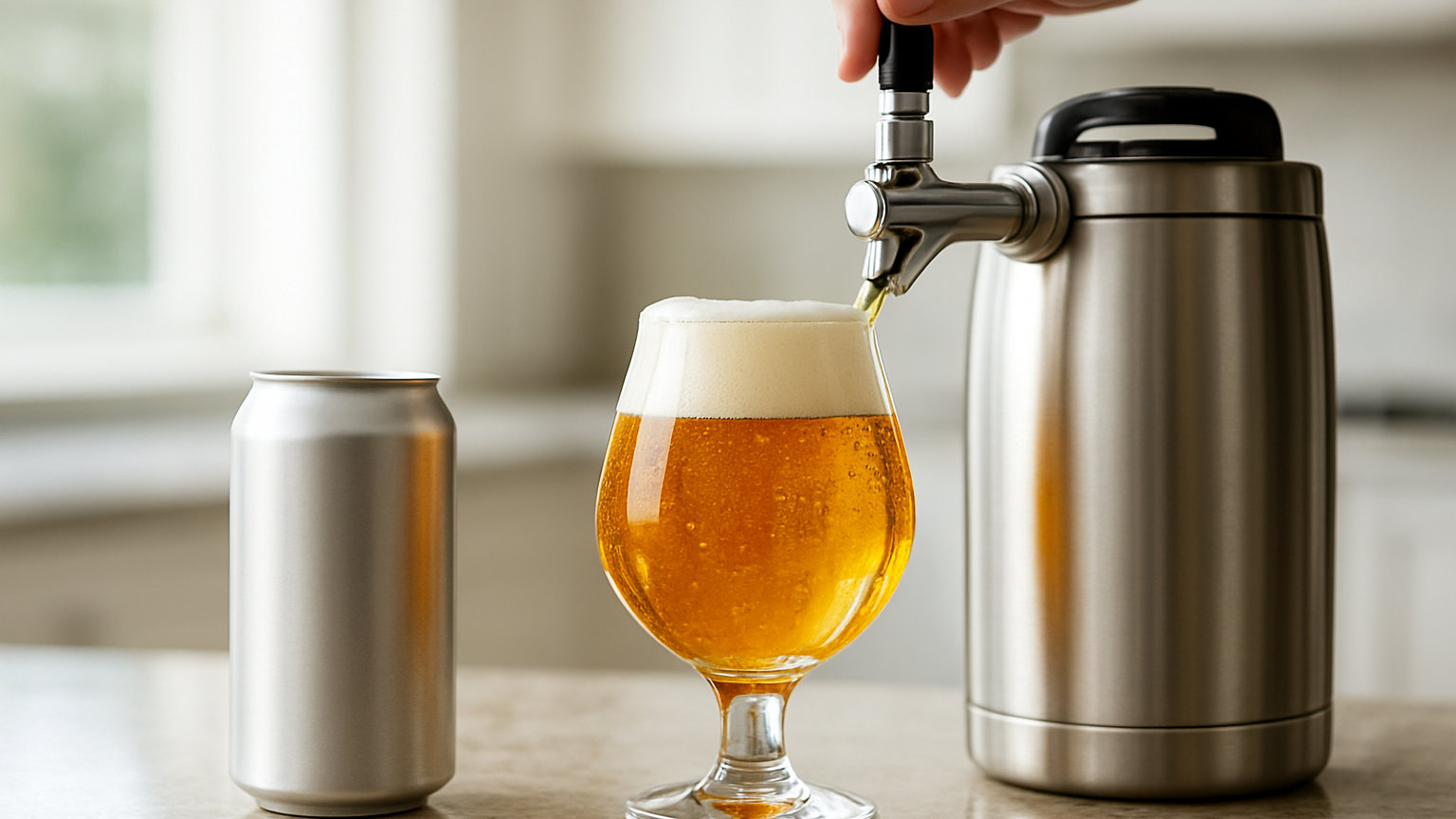
Pouring your own draught beer at home is an appealing idea, and the equipment ranges from a five litre can with a tap on it to a converted fridge with gas cylinders and cooled lines. Whether any of it is worth the money depends on how much beer you actually drink.
Mini kegs
The simplest option: a five litre container, roughly eight and a half pints, with a tap and either a self-pressurising system or a small gas cartridge.
They work adequately and have a short life once opened, typically a few days, since the pressurising system is rudimentary and oxygen gets in. Five litres is more than most people finish in that time.
They are best treated as a party format rather than as a permanent fixture, and the beer inside is generally a mainstream lager rather than anything interesting.
Kegerators
A refrigerator adapted to hold a keg, with a carbon dioxide cylinder, a regulator, lines and a tap through the door.
This is a genuine draught system and produces excellent results. It also involves real commitment: the initial cost of the unit and gas equipment, keg deposits, cylinder refills, and regular line cleaning.
Kegs commonly come in nine, twenty or thirty litre sizes, which is between fifteen and fifty pints of a single beer. Unless you drink a great deal of one thing, or entertain frequently, that is a lot of the same beer.
Small kegs and the reusable containers used by home brewers offer more flexibility, and several breweries sell in formats intended for home dispense.
Cask at home
A pin, which is four and a half gallons, or a firkin at nine gallons can be bought from some breweries for an event.
Cask requires stillaging, settling for a day or more, venting and tapping, and once broached the beer has around three days. It is a poor choice for casual use and an excellent one for a party, since a properly kept cask served by gravity is superb.
Some breweries will lend or hire the equipment and will explain the process, which is worth taking up if you have never done it.
The cleaning problem
This is the part people underestimate. Beer lines accumulate yeast and bacterial films exactly as they do in a pub, and an uncleaned home system will make every beer taste sour and musty within weeks.
Cleaning means flushing with a proper line cleaning solution, soaking and rinsing, every couple of weeks. It takes half an hour and cannot be skipped.
A system that is not cleaned regularly produces worse beer than a can, which rather defeats the purpose.
The economics
Draught beer bought in kegs is generally cheaper per pint than cans, sometimes substantially. Against that sit the equipment cost, gas, deposits and the beer wasted during cleaning.
The break-even point requires drinking a considerable amount, and most households never reach it.
The stronger argument is not financial but experiential: a properly poured pint from a well kept home system is a better drink than the same beer from a can, and some people value that enough to justify the effort.
What most people should do instead
Buy cans, pour them into a decent glass at the right temperature, and spend the money on better beer.
Cans are sealed, light-proof, packaged with minimal oxygen and available in enormous variety, and the difference between a well poured can and a home draught pint is far smaller than the difference between fresh beer and stale.
If the appeal is the tap on the wall rather than the beer in the glass, that is a legitimate reason to want one, and it is worth being honest that it is the reason.
If you do buy one
Buy the cleaning equipment at the same time, since a system without a proper cleaning kit will not be cleaned properly.
Check what keg fittings your local breweries use before committing, as several incompatible types exist and a system that will not connect to anything available nearby is an expensive ornament.
And consider where it will live. A kegerator is a fridge-sized appliance that runs constantly, makes noise and needs space around it, which is worth thinking about before it arrives rather than afterwards.


