
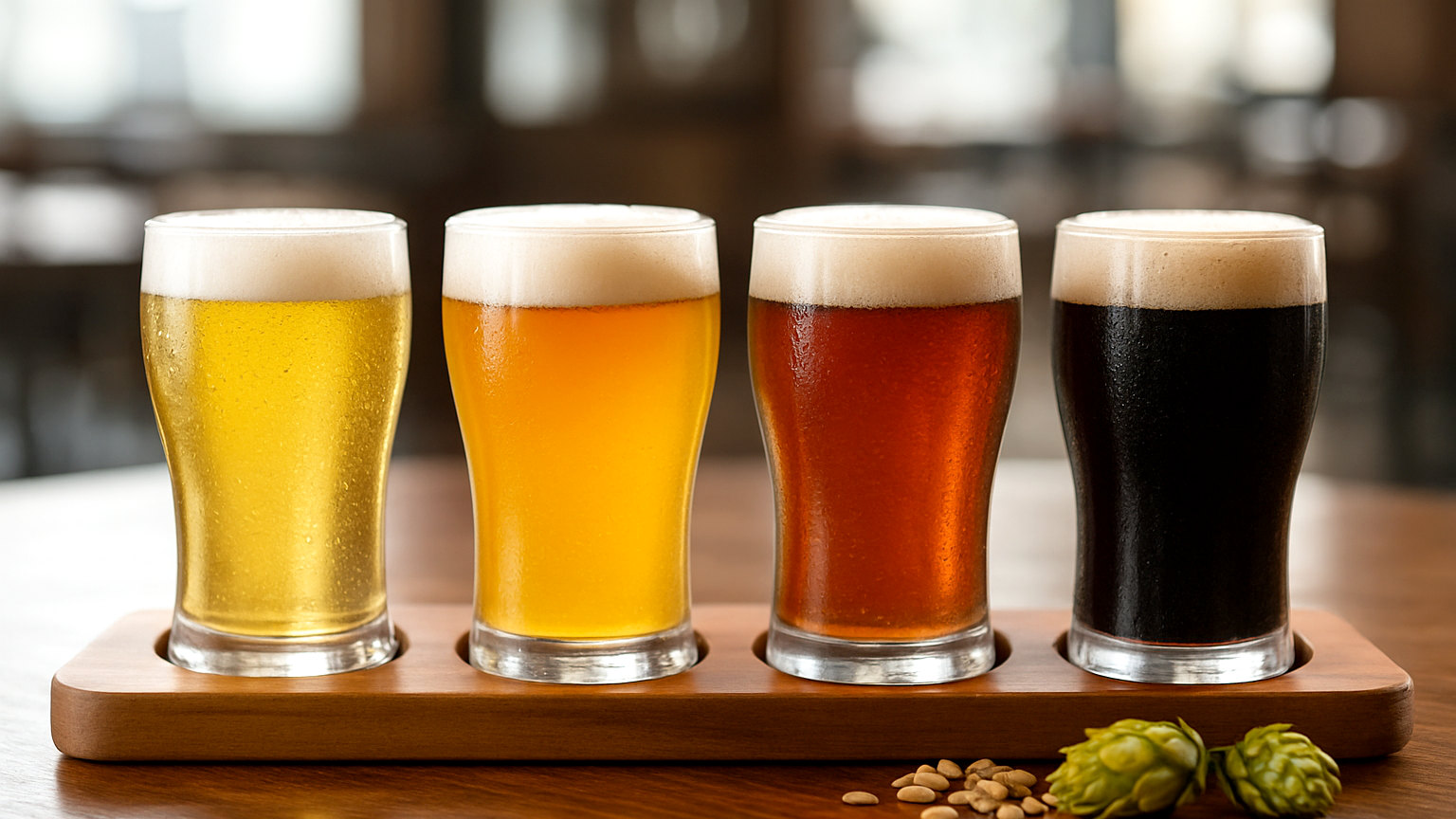
A flight is a selection of small measures, usually three to five, served together on a board or a paddle. Taprooms and beer bars offer them as a way to try several things, and they are the most efficient way to learn what you like.
They are also frequently ordered badly, which wastes the point.
What you get
Measures are typically a third of a pint or smaller, often around a sixth, and three to five beers is standard.
Cost is usually comparable to a pint and a half, so a flight is not a saving on volume. What you are buying is comparison, which is worth considerably more than volume when you are trying to work out what a brewery does well.
The order matters
Palate adaptation is real: anything tasted after something more intense will seem weaker by comparison.
The sequence is the same as for wine. Light before heavy, low alcohol before high, dry before sweet, and anything sour or strongly hopped later rather than earlier, since both dominate what follows.
A sensible flight might run pilsner, pale ale, IPA, stout. A poor one starts with an imperial stout and finishes with a lager tasting of nothing.
Most bars serve them in a sensible order, and it is worth asking which is which if the board is not labelled.
Choosing what goes in it
The most useful flights hold something constant. Four beers from the same brewery show house character. Four versions of the same style show how much interpretation varies. Two pairs, one hoppy and one dark, cover more ground.
The least useful flight is four unrelated beers chosen because the names sounded interesting, since there is nothing to compare.
If you are new to a brewery, ask what they are known for and include it, along with one thing you would not normally order.
How to drink it
Taste in order, then go back. The value is in returning to the first beer after the last and noticing what has changed, which is impossible if you finish each glass before moving on.
Drink water between them, and eat something plain if the flight is more than four.
Beyond five or six beers, discrimination falls away sharply, which is why flights are small and why ordering two in succession is less useful than it sounds.
Write a line about each if you are trying to learn something, since the memory of four similar beers fades within the hour.
Where flights work best
Taprooms, where the range is one brewery's output and the comparison is between their beers rather than between breweries.
Beer festivals, which are effectively a flight you assemble yourself, and where third-pint measures allow a great many comparisons in an afternoon.
And bars with a rotating range, where a flight is a way of finding which of six unfamiliar taps is worth a full glass.
What to do afterwards
Order a full measure of the one you liked most. That is the actual purpose: a flight is a decision-making tool rather than a destination, and drinking a proper glass of a beer you have chosen deliberately is a better experience than four sips of things you have not.
It is also worth noting the alcohol involved. Five thirds is more than a pint and a half, and a flight of strong beers can add up faster than it appears, since the measures look small.
Making one at home
The same idea works with cans and a few small glasses, and it costs less than a flight in a bar.
Buy four beers around a theme, pour a third of each into separate glasses, and taste them in order with water in between. Sharing the exercise between two people halves the quantity and doubles the conversation.
The leftovers keep for a few hours in a sealed can in the fridge if you want to return to them, though the carbonation will have gone by the following day.


