
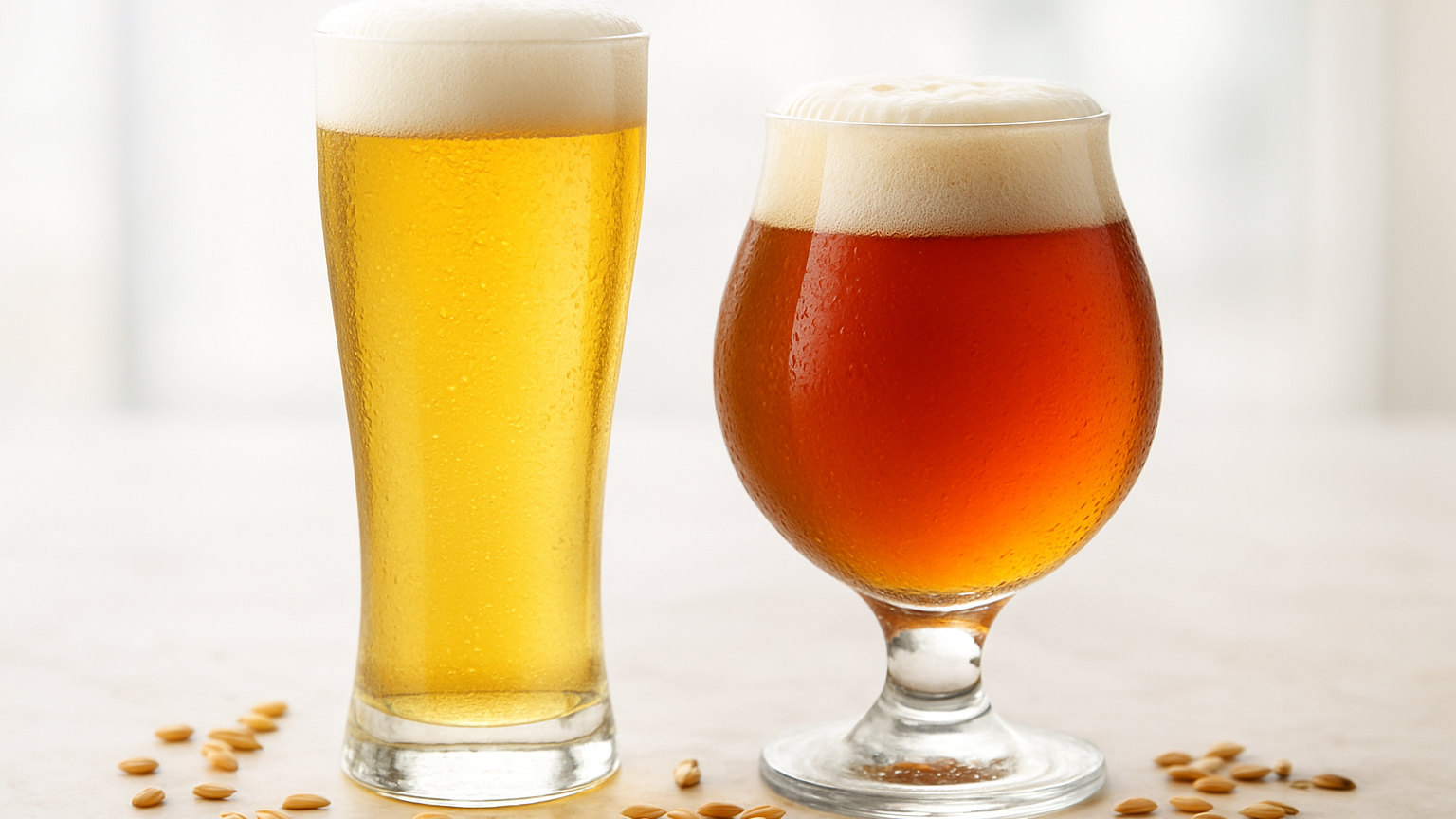
Beer has accumulated more glass shapes than any other drink, most of them tied to a specific style or region and most of them justified by tradition rather than testing. Shape does matter, and considerably less than the number of available glasses implies.
What shape actually does
Three features do real work.
A bowl that narrows towards the rim concentrates aroma above the beer and directs it towards the nose. For any beer where smell matters, this is the single most useful feature.
A shape that supports a head keeps foam in play, and since the head carries aroma and protects the beer, that matters too.
And the width of the opening affects how quickly the beer warms in the hand, which is why stems and smaller measures exist for stronger beers.
Everything else, including the elaborate variety of regional shapes, is largely custom and presentation.
The traditional shapes and what they suit
The nonic pint, with the bulge near the top, is the British workhorse. It stacks safely and is easy to hold, and it does nothing whatever for aroma.
The tulip, wider at the bowl and narrowing at the rim, is the most useful shape in beer and suits IPA, Belgian ales, strong stouts and almost anything aromatic.
The teku, a stemmed tulip on a long stem, is the modern craft standard and does the same job while keeping your hand off the bowl.
The weizen glass is tall and flaring, designed to hold the enormous head a wheat beer produces.
The pilsner glass is tall and tapered, showing off clarity and carbonation.
The stange is a narrow cylinder for kölsch, served in small measures and replaced frequently. The snifter suits barley wine and imperial stout, where a small measure and a wide bowl let you warm the beer in your hand.
Mugs and steins keep the hand off the beer and prevent you seeing it, which is a fair trade on a hot day.
Nucleation
Many modern glasses have a laser-etched pattern on the base. This is not decoration: carbon dioxide needs a nucleation site to form a bubble, and a smooth glass provides very few, so the gas stays dissolved and the head collapses.
An etched base produces a continuous stream of bubbles, maintaining the head and carrying aroma upwards throughout the drink. It works, and it is one of the few glassware features with a clear mechanism.
What to own
Two shapes cover almost everything.
A tulip or teku of around four hundred millilitres handles IPA, pale ale, stout, porter, Belgian ales, sours and anything strong or aromatic. Buy four or six.
A pint glass, ideally nucleated and lined, handles lager, bitter, mild and anything drunk in volume.
If you want a third, a weizen glass for wheat beer is the one with a genuine functional argument, since nothing else holds the head properly.
Everything beyond that is collecting, which is an enjoyable hobby and not a requirement.
The thing that matters more
A clean glass beats a correctly shaped dirty one every time. Detergent residue and fat destroy head retention and dull aroma, so rinsing thoroughly and storing glasses upright rather than inverted does more for your beer than buying a specialist shape.
Pouring into the right amount of space matters as well. Filling a tulip to the brim removes the headspace the shape exists to create, and two thirds full is the useful maximum for anything aromatic.
Do brewery-branded glasses matter?
Breweries supply branded glassware to pubs and sell it to drinkers, and the shape is usually chosen to suit their beer, which makes it a reasonable guide.
Whether a particular brewery's tulip is better than another's is generally a matter of branding rather than design, since most fall into the same handful of shapes.
Where branded glassware genuinely helps is in a pub, since a bar serving a beer in its own glass has usually thought about how it is presented. It is a small signal and a reliable one.


