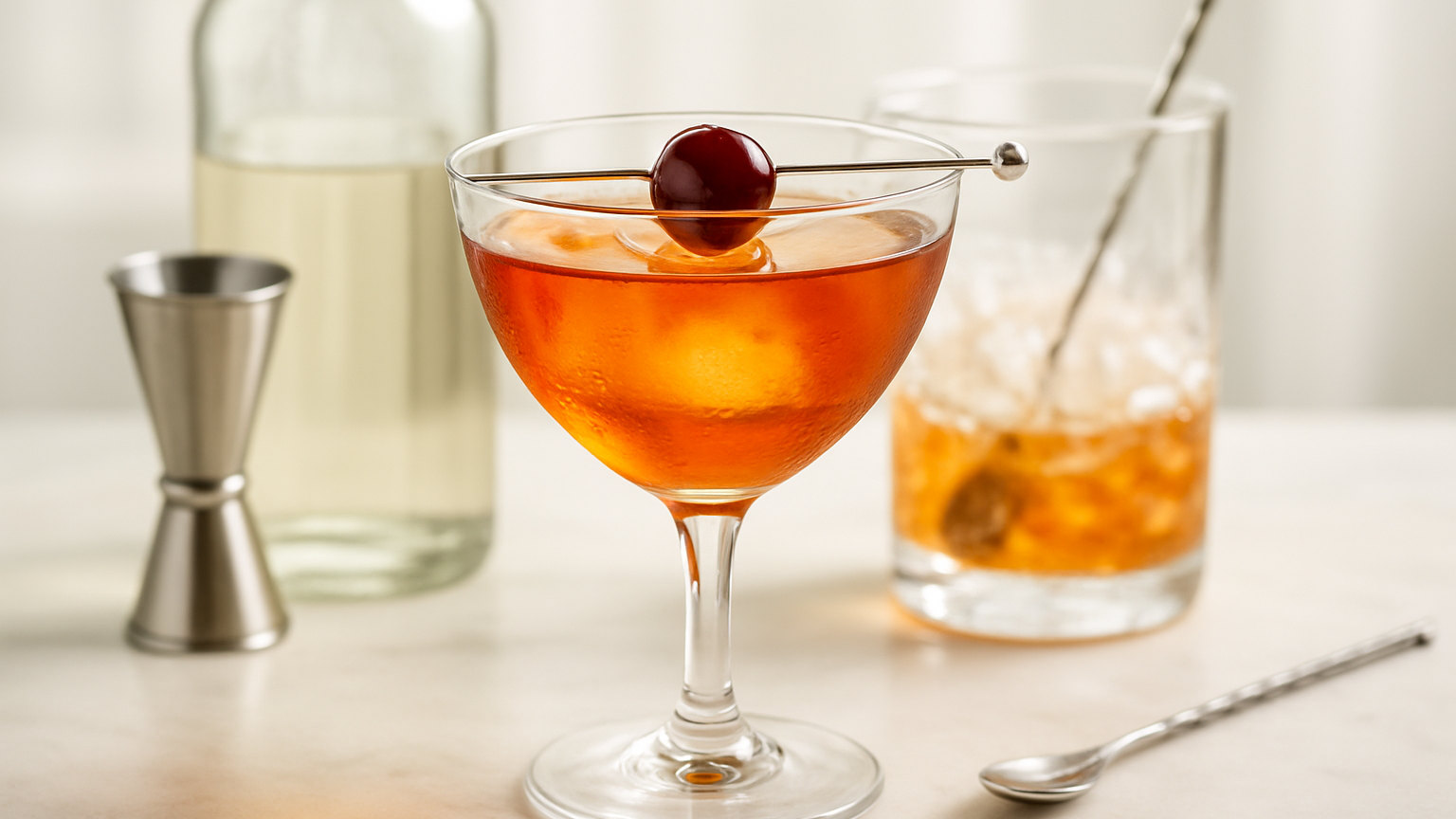
The Manhattan is one of the oldest surviving cocktails and one of the simplest: whiskey, sweet vermouth and bitters, stirred and served straight up with a cherry. It is also the drink where a stale bottle of vermouth does the most damage.
The recipe
Combine 60 millilitres of rye whiskey, two ounces, with 30 millilitres of sweet vermouth, one ounce, and two dashes of aromatic bitters in a mixing glass with ice.
Stir for around thirty seconds until cold and properly diluted. Strain into a chilled coupe or a small stemmed glass.
Garnish with a good cocktail cherry, preferably one preserved in syrup and liqueur rather than the bright red confectionery kind.
Some bartenders prefer a lemon twist instead, expressed over the surface, which produces a brighter drink.
Why rye
Rye is the traditional base and remains the better choice for most palates. Its dryness and pepper give the sweet vermouth something to push against, and the finished drink is balanced rather than sweet.
Bourbon works and produces a rounder, sweeter, softer Manhattan. Anyone who finds the rye version too sharp should try it, and anyone who finds the bourbon version cloying should switch back.
Strength matters. A whiskey at forty five per cent or above survives the dilution better than one at forty, and bottled-in-bond expressions at fifty per cent are particularly good here.
The vermouth problem
This is where most home Manhattans go wrong, and it is worth stating plainly. Sweet vermouth is fortified wine at around fifteen to sixteen per cent, and it oxidises exactly as wine does.
An open bottle kept in a cupboard is noticeably stale within a few weeks and unpleasant within a couple of months. Since vermouth is a third of the drink, a stale bottle ruins it entirely, and no amount of good whiskey compensates.
Keep it in the fridge, buy the smallest bottle available, and replace it within a month or two of opening. That single habit improves a home Manhattan more than upgrading the whiskey.
The ratio
Two parts whiskey to one part vermouth is the modern standard and a sensible starting point.
Historical recipes frequently used equal parts, which produces a sweeter, more vermouth-driven drink that is worth trying at least once, particularly with a good vermouth.
Drier versions at three to one or four to one are common in bars, and which you prefer depends on the whiskey and on the vermouth.
The named variations
A perfect Manhattan splits the vermouth, using equal quantities of sweet and dry, which produces a lighter and more herbal drink. The word perfect refers to the split rather than to quality, which catches people out.
A dry Manhattan uses dry vermouth in place of sweet and is usually garnished with a lemon twist rather than a cherry.
A Rob Roy is the same drink made with Scotch, which gives a smokier, more savoury result depending on the whisky chosen.
A Vieux Carré adds cognac, Bénédictine and a second style of bitters, and is one of the more complex drinks in the classic canon.
Technique
Stir, never shake. There is no citrus juice and no egg, so shaking would aerate the drink, cloud it and dilute it unevenly. A Manhattan should be clear and silky.
Chill the glass first with ice and water while you stir, then discard it. A warm glass undoes thirty seconds of careful stirring within a minute.
And serve it in a small glass. This is a drink of roughly ninety millilitres before dilution and a good deal of alcohol, and a large glass encourages a larger pour than the drink is designed for.
The cherry
The garnish is worth spending on. Bright red confectionery cherries are bleached and re-dyed and contribute a synthetic sweetness that sits oddly against the drink.
Proper cocktail cherries, preserved in syrup and frequently in liqueur, are dark, firm and genuinely good to eat. A jar is not cheap and lasts a long time in the fridge.
It is a small detail with a disproportionate effect on how the drink reads, since the cherry is the last thing you taste.