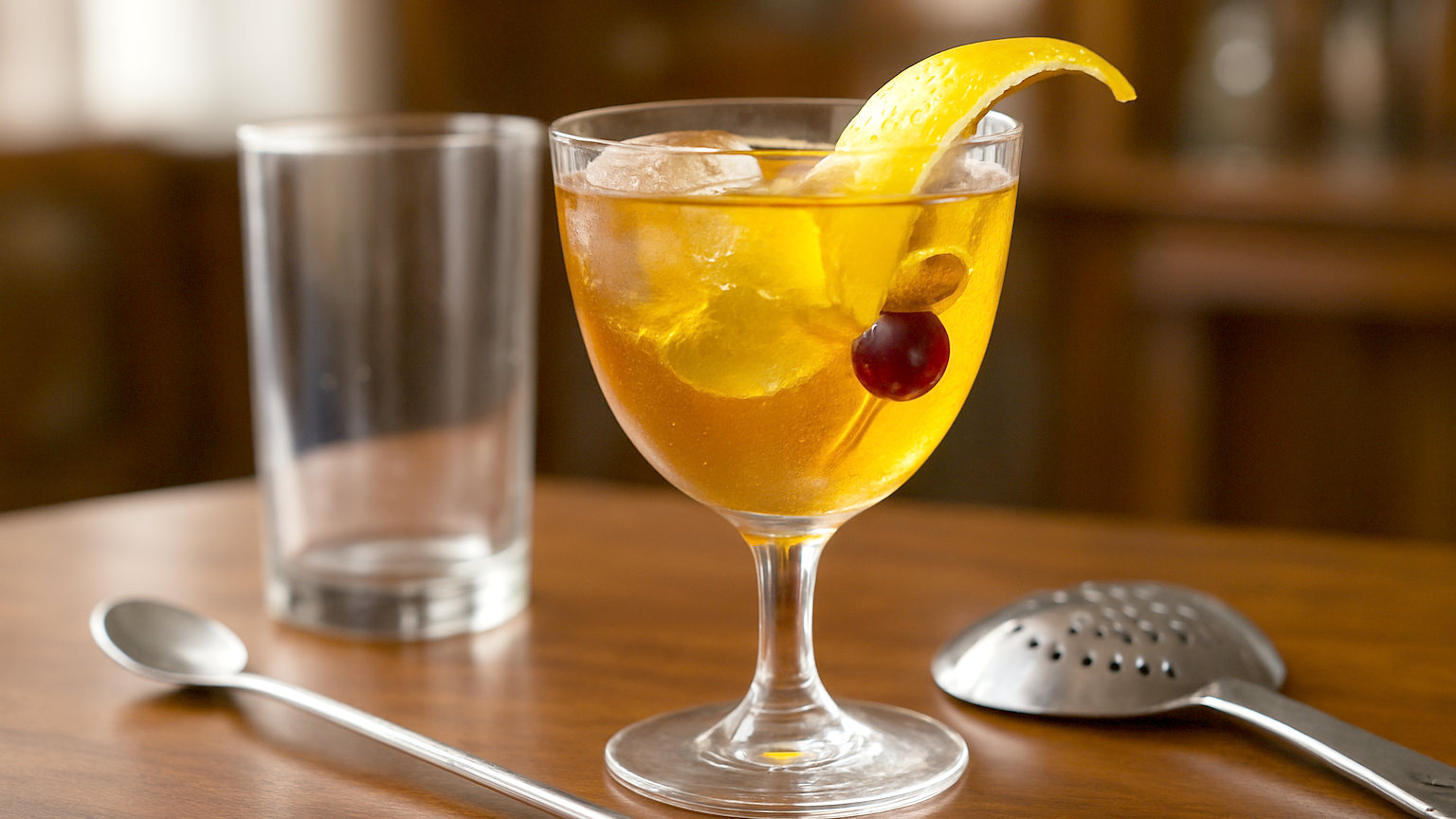
The Martinez is gin, sweet vermouth, maraschino liqueur and bitters, stirred and served up. It appears in bar books from the 1880s onwards and is routinely described as the drink from which the martini descends.
The recipe
Combine 45 millilitres of Old Tom gin with 45 millilitres of sweet vermouth, one teaspoon of maraschino liqueur and two dashes of aromatic or orange bitters.
Stir with ice for thirty seconds and strain into a chilled coupe.
Garnish with a lemon twist expressed over the surface.
Modern versions frequently use more gin and less vermouth, at two to one, which produces a drier drink closer to modern tastes. The equal parts version is what the old books specify.
Old Tom gin
A style that sits between genever and London dry: lightly sweetened, fuller bodied and softer than a modern dry gin.
It largely disappeared during the twentieth century and has been revived by several producers, and it is worth buying if you intend to make Victorian-era drinks, since a good many of them assume it.
A London dry works and produces a sharper, drier Martinez that is recognisably a different drink. Adding a small amount of sugar syrup goes some way towards the difference.
Maraschino
A clear liqueur made from marasca cherries including the stones, which give it a distinctive nutty, almost funky character quite unlike sweet cherry liqueur.
It is assertive, so a teaspoon is the correct quantity and more will dominate. This is true of most of the older liqueurs, which were formulated for use in small measures.
A bottle lasts for years and also makes the last word, the Hemingway daiquiri and several others, so it earns shelf space.
The ancestry question
The story goes that a bartender in San Francisco made the drink for a traveller heading to the town of Martinez, or that it originated in that town, and that it evolved into the martini as tastes moved drier and Old Tom gave way to London dry.
The evidence is suggestive. The Martinez appears in print earlier than the martini, the structure is clearly related, and the trajectory from sweet to dry matches how tastes moved generally.
What is missing is documentation connecting the two directly. Both drinks appear in the same period, and it is equally possible that they developed alongside each other from a shared idea of gin and vermouth.
The confident origin stories attached to both should be treated as folklore, which is the normal position for cocktails of this vintage.
What it tells you about how tastes changed
This is the genuinely interesting part.
The Martinez is sweet, aromatic and complex. The martini as it was made in the 1950s is dry, austere and minimal. The distance between them is a century of drinking becoming drier.
The same movement is visible across the canon. Older recipes are consistently sweeter, older gins were sweeter, and older sours used more sugar.
Modern bartending has moved partway back, with wetter martinis and renewed interest in Old Tom and in the older sweeter drinks.
Whether to make one
Yes, particularly if you find modern martinis austere. It is a considerably more approachable drink and a genuinely good one.
It also demonstrates something useful: that the drink most associated with dryness and minimalism began, on the available evidence, as something sweet and busy.
Related drinks worth knowing
The Turf, the Tuxedo and the Marguerite all appear in books of the same period and are variations on gin and vermouth with different modifiers.
None survived into general use, and several are excellent. Working through a nineteenth century bar book turns up a good many drinks abandoned for reasons of fashion rather than quality.
The common thread is that they are wetter and more aromatic than modern taste expects, which makes them a useful corrective for anyone who assumes cocktails have always been dry.