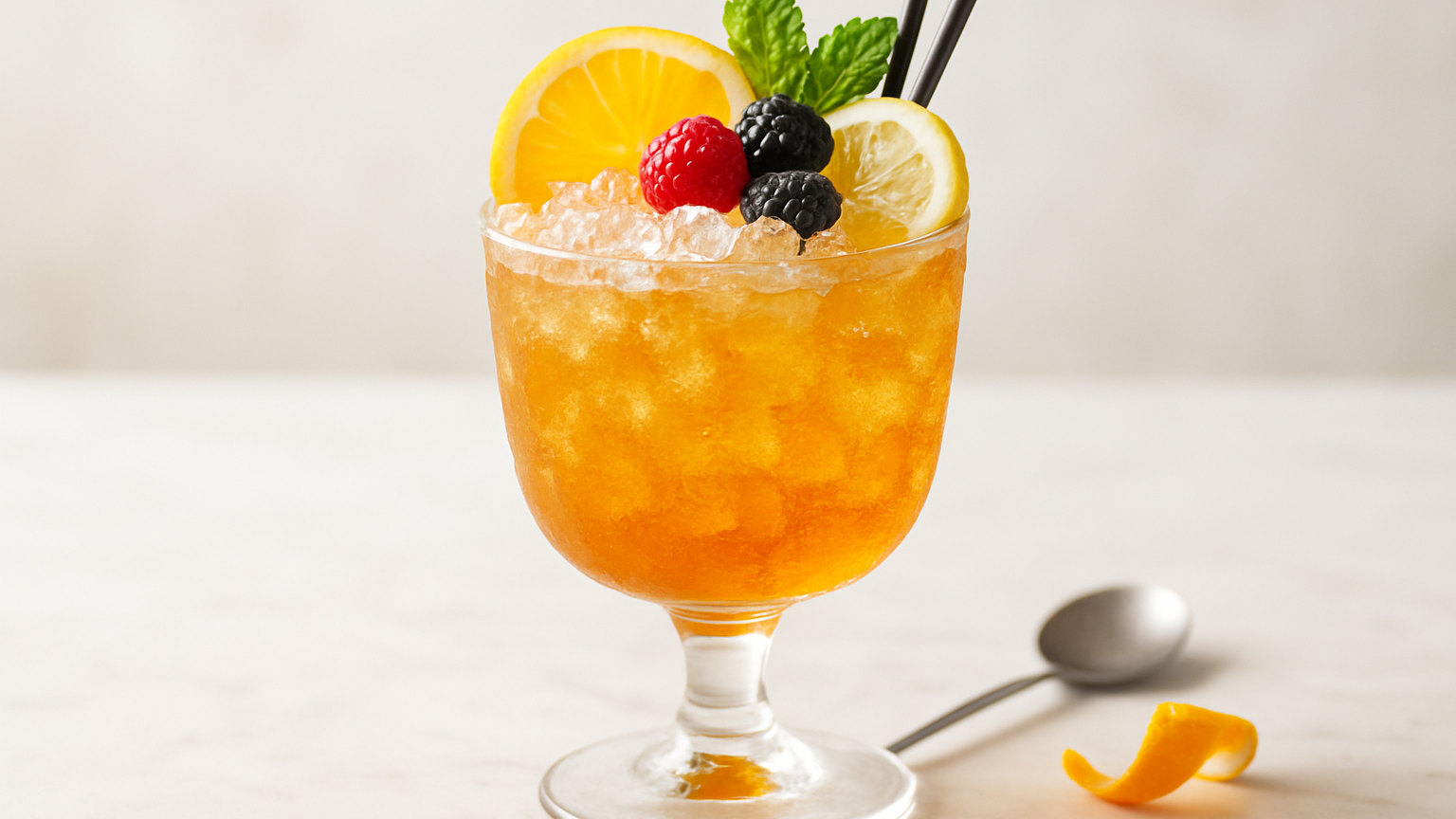
The cobbler is wine or fortified wine with sugar and fruit, served over crushed ice. In the middle of the nineteenth century it was among the most popular drinks in America and it was widely credited with popularising the drinking straw.
The sherry cobbler
The classic version and still the best.
Combine 90 millilitres of amontillado or oloroso sherry with 15 millilitres of sugar syrup and two or three orange slices in a shaker.
Muddle the orange gently, add ice and shake briefly.
Strain into a tall glass packed with crushed ice.
Garnish generously with seasonal fruit and a mint sprig, and serve with a straw.
Why crushed ice
The drink depends on it. Crushed ice chills rapidly and dilutes continuously, so a cobbler starts as a concentrated wine drink and becomes progressively longer and more refreshing.
It also holds the fruit in suspension rather than letting it sink, which is part of the presentation.
Crushing it at home is straightforward: wrap cubes in a clean tea towel and hit them with a rolling pin.
The straw
The cobbler is frequently credited with popularising drinking straws, since a drink packed with crushed ice and fruit is awkward to drink from the rim.
Early straws were made from rye grass, and the paper straw was patented later in the century, reportedly by someone dissatisfied with how grass straws disintegrated.
The attribution is repeated widely and, like most drinks history of the period, rests on limited evidence. What is clear is that the two became associated.
Why it is coming back
Strength, mostly. A sherry cobbler sits at around seven to nine per cent in the glass before the ice melts, and considerably less afterwards.
That makes it one of the genuinely good low-strength options: a drink with real complexity that you can have two of over an afternoon.
Interest in sherry has also grown substantially, and the cobbler is among the best ways to drink it in a long format.
The visual appeal helps, since a glass of crushed ice packed with fruit photographs well, which matters more for a drink's spread than it should.
Which sherry
Amontillado is the reliable choice: nutty, dry and with enough body to survive the dilution.
Oloroso is richer and produces a fuller drink.
Fino and manzanilla are lighter and drier, and they can be lost against the sugar and fruit, though a fino cobbler with less syrup is excellent in summer.
Pedro Ximénez is far too sweet on its own and works as a small proportion alongside a drier sherry.
Variations
The template is a fortified or aromatised wine, sugar and fruit over crushed ice, which accepts substitution freely.
Port makes a richer cobbler suited to autumn.
Madeira works particularly well, since its acidity survives the dilution.
Vermouth, either sweet or dry, makes an excellent cobbler at around eight per cent.
Whisky and brandy cobblers appear in the historical literature and are considerably stronger, which rather removes the point of the style.
Seasonal fruit is the other variable: berries in summer, orange and pomegranate in winter, stone fruit in late summer.
Making it well
Do not over-muddle the fruit. Bruising the orange releases oil from the skin, which is what you want; pulverising it releases bitterness from the pith.
Shake briefly rather than hard, since the crushed ice will provide further dilution.
Pack the glass properly with crushed ice and mound it above the rim, then add the garnish on top.
And keep the sherry in the fridge once opened. It is wine, and an open bottle goes stale within a couple of weeks.
Batching it
The cobbler batches reasonably well provided the fruit is handled separately.
Combine the sherry and the syrup in advance and refrigerate. Muddle the orange fresh in each glass, or make a large batch of orange oleo saccharum in place of the syrup.
Assemble over crushed ice at the point of serving, since a cobbler made in advance and left standing loses the layered dilution that makes it work.