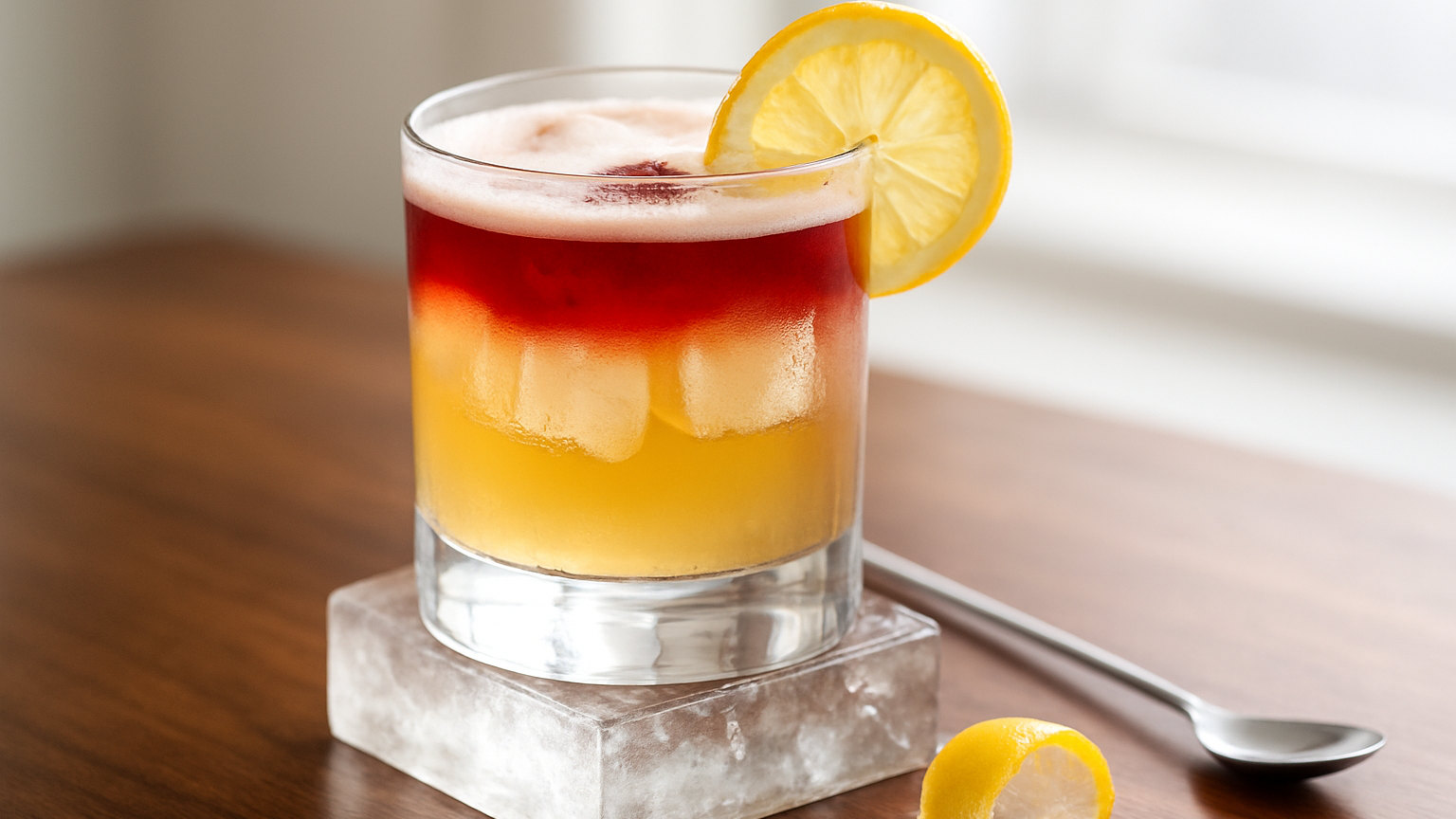
A New York sour is a whiskey sour with a layer of red wine floated on the surface. It looks like a piece of theatre and it changes the drink genuinely, adding tannin, fruit and a shifting character as you drink through the layer.
The recipe
Combine 50 millilitres of bourbon or rye, 25 millilitres of fresh lemon juice and 20 millilitres of sugar syrup.
Shake hard with ice and strain over a large cube in a rocks glass, or into a chilled coupe.
Float 15 to 20 millilitres of red wine on top by pouring it slowly over the back of a bar spoon held just above the surface.
An egg white in the base is optional and makes the float considerably easier, since the foam gives the wine something to sit on.
Why the wine floats
Density. The base of the drink contains a substantial quantity of sugar syrup, which makes it denser than the wine sitting on top.
Red wine at around thirteen per cent alcohol with very little residual sugar is lighter than a sweetened, diluted spirit mixture, so it stays where it is put provided it is not disturbed.
The technique of pouring over a spoon works by spreading the liquid across a wide surface and slowing it, so it settles rather than plunging through.
If the float sinks, the base was not sweet enough, the pour was too fast, or the wine was too heavy. Adding a little more syrup to the base solves it.
What it contributes
Tannin, which the base sour lacks entirely, giving structure and a drying finish.
Dark fruit character, which sits against the bourbon's vanilla and caramel.
A gradient. The first sips are wine-forward, the middle is a blend, and the end is the whiskey sour underneath. The drink changes as you go, which is the same effect a bramble achieves with its liqueur drizzle.
And visually it is striking, which is a fair part of why the drink survived.
Which wine
Something dry, fruit-forward and not too tannic or oaky.
Malbec, shiraz, merlot and zinfandel all work well. A young, fruity red is better than an expensive structured one, which will fight the drink.
Avoid anything heavily oaked, since the vanilla will double up with the bourbon, and avoid very light reds, which disappear.
This is a good use for the last glass of an open bottle, which is one of the drink's practical virtues.
The name and the history
The drink appears in nineteenth century sources under several names, including the claret snap and the continental sour, and the New York attribution came later.
Floating wine on a sour was a recognised technique of the period rather than a single invention, which is a common pattern in cocktail history.
The float as a technique
Worth generalising, since it applies widely.
Any liquid less dense than the drink beneath will float if poured gently, and sugar content is the main determinant of density.
The penicillin uses the same idea with a peated whisky, delivering smoke aromatically without letting it dominate the liquid.
The bramble drizzles a liqueur over crushed ice so it descends in streaks.
A dark and stormy floats dark rum over ginger beer.
In each case the point is the same: an ingredient that would overwhelm the drink if mixed in becomes an aromatic and visual layer instead, and the drink changes as you work through it.
Should you stir it in
Stirring the wine through produces a uniformly pink drink with the tannin distributed evenly, which is pleasant and loses the gradient entirely.
Leaving it layered means the experience changes from first sip to last, which is the drink's distinguishing feature and the reason the float exists.
Most people who try both prefer it layered, and it costs nothing to leave the spoon out and find out for yourself.
Serving it
Over a large ice cube in a rocks glass is the usual approach and the more forgiving one, since the drink stays cold while you work down through the layer.
Served up in a coupe it looks better and warms faster, and the float sits more precariously without foam beneath it.