Absinthe is a high strength spirit flavoured with wormwood, anise and fennel, usually bottled between 45 and 74 per cent. It was banned across much of Europe and the United States in the early twentieth century and legalised again from the 1990s onwards, and the reasons for both are worth separating from the folklore.
What is in it?
The three core botanicals are grande wormwood, green anise and sweet fennel, sometimes called the holy trinity. Additional herbs including hyssop, melissa and petite wormwood are commonly used, particularly in the colouring step.
Traditional production distils the botanicals with a neutral or grape based spirit, then steeps additional herbs in the distillate to produce the natural green colour through chlorophyll. Cheaper products skip this and use artificial colouring, which is a reasonable quality signal.
Why was it banned?
A combination of factors, and the botanical was the least of them. Absinthe was enormously popular in France in the late nineteenth century, cheap, very strong, and consumed in large quantities.
The temperance movement campaigned against it, and the wine industry, which had suffered badly from phylloxera while absinthe boomed, had commercial reasons to support the campaign. A widely publicised murder case in Switzerland in 1905, in which the perpetrator had drunk absinthe alongside a great deal of other alcohol, provided the trigger.
Bans followed across Switzerland, France, the United States and elsewhere between 1905 and 1915.
Does it cause hallucinations?
No. The claim centred on thujone, a compound in wormwood, which was said to be psychoactive.
Later analysis of both historic and modern bottles found thujone at levels far too low to produce any such effect. The quantity a drinker would need to consume to approach a pharmacologically significant dose would involve a fatal amount of alcohol first.
What absinthe does have is a very high alcohol content, which is a sufficient explanation for the behaviour of nineteenth century drinkers consuming several glasses of it daily. Contemporary regulations cap thujone levels, and modern absinthe complies comfortably.
When was it legalised?
Progressively from the late 1980s onwards as European regulations were harmonised, with most countries permitting sale by the early 2000s. The United States allowed it again from 2007, subject to thujone limits.
How should it be served?
Diluted, always. Neat absinthe at 68 per cent is unpleasant and pointless.
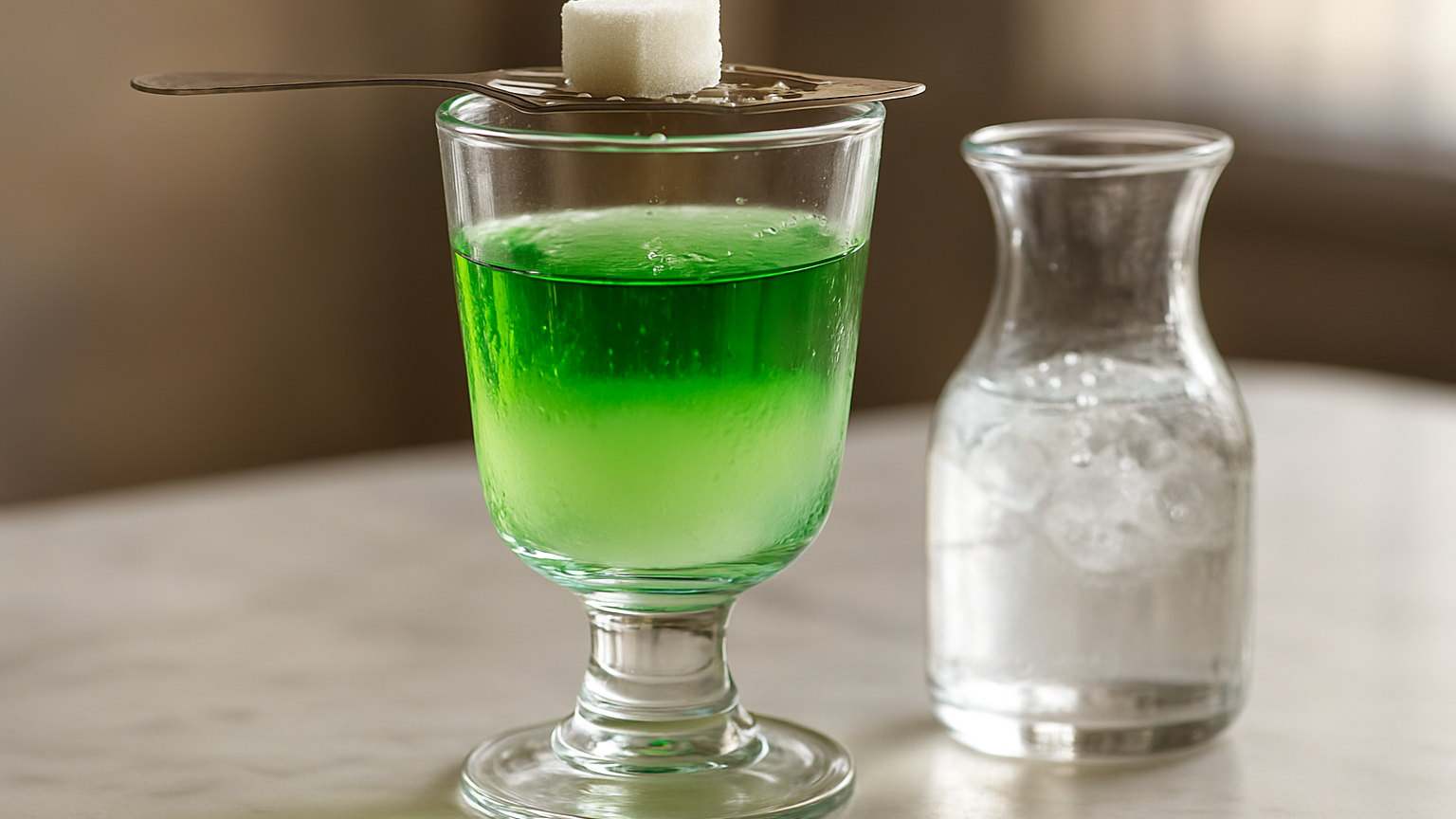
- Pour a measure of absinthe into a glass.
- Rest a slotted spoon across the rim, with a sugar cube on it if you want sweetness.
- Drip iced water slowly over the sugar until the ratio is roughly three to five parts water to one of absinthe.
- Stir and drink slowly.
The burning sugar cube ritual is a modern invention associated with poor quality Czech products from the 1990s, not a traditional practice, and it does nothing for the drink beyond setting fire to it.
Why does it turn cloudy?
The louche effect. Anethole, the compound responsible for the anise flavour, dissolves in alcohol but not in water. As water is added, it comes out of solution and forms a fine suspension, turning the drink opalescent.
The same happens with ouzo, pastis, raki and sambuca. A slow, thick louche is generally a sign of a properly distilled absinthe rather than a coloured, flavoured spirit.
What do you use it for?
A sazerac rinse is the classic cocktail use, coating the glass and discarding the excess. It also appears in a corpse reviver number two, a death in the afternoon and several other drinks, always in very small quantities.
Given how little any recipe needs, one bottle lasts a very long time.
Is it worth buying?
Only if you make the drinks that call for it, since a sazerac uses a few millilitres as a rinse and most other recipes use a dash. A bottle bought out of curiosity will last decades.
If you do buy one, look for a naturally coloured absinthe from a traditional producing region rather than a bright green product with artificial colouring, and treat the strength with respect. At 60 per cent and above it needs the water it was always designed to be served with.