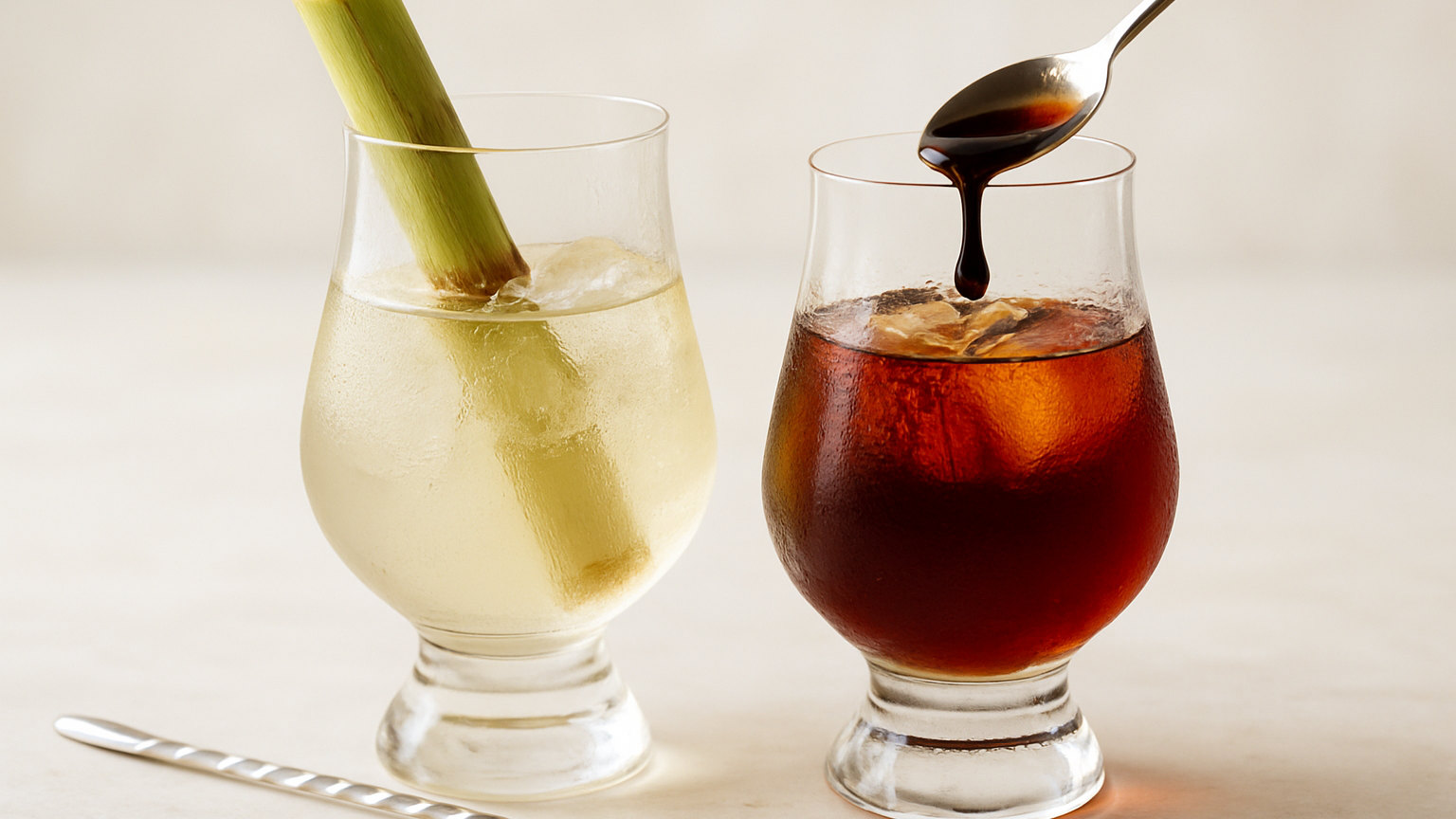
Rum divides at the very first step. Either the cane juice was boiled down and the sugar crystallised out, leaving molasses to ferment, or the fresh juice was fermented directly. The two routes produce spirits so different that a blind taster can separate them immediately.
What is molasses?
Molasses is the syrup remaining after sugar crystals have been extracted from concentrated cane juice. It is dark, viscous and still contains a substantial proportion of unfermentable sugars, minerals and organic compounds.
Its great practical advantage is stability. Molasses can be stored for months and shipped anywhere, which means a distillery need not sit next to a cane field and need not stop production when the harvest ends. That is why the overwhelming majority of rum in the world is made from it.
What does molasses rum taste like?
Rich and sweet in character, with caramel, toffee, dried fruit, brown sugar and baking spice. The exact profile depends far more on fermentation length and still type than on the molasses itself, so the range runs from light and clean to intensely funky.
What molasses reliably contributes is depth and a certain darkness of flavour, even in a white rum, and a body that fresh cane juice does not produce.
What does cane juice rum taste like?
Grassy, vegetal, herbaceous and often distinctly savoury, with olive brine, green pepper and fresh cut grass alongside the sweetness. It is brighter and sharper, and it can be startling to anyone who expects rum to taste like caramel.
Cane juice ferments and spoils quickly, so production has to happen near the fields and within the harvest season. This makes it a seasonal, geographically constrained product and partly explains why it remains the minority style.
Which countries use which?
- Molasses: Jamaica, Barbados, Guyana, Cuba, Puerto Rico, the Dominican Republic, Venezuela, Panama, Trinidad, most of Asia and most large scale producers everywhere.
- Cane juice: Martinique, Guadeloupe, Haiti, Marie-Galante and other French speaking islands, plus Brazil, and a growing number of small producers elsewhere.
Several distilleries make both, and blends of the two exist, so the country is a strong indicator rather than a rule.
How do cachaca and rhum agricole fit in?
Both are cane juice spirits, and the differences are legal and stylistic rather than fundamental.
Rhum agricole is the French Caribbean style, most tightly regulated in Martinique where it holds a protected appellation covering cane varieties, yields, fermentation and distillation. It is typically distilled in single column creole stills to a relatively low strength, retaining plenty of character.
Cachaca is the Brazilian equivalent and the base of a caipirinha. It must be distilled between 38 and 48 per cent, which is lower than the usual rum range, and it is often aged in native Brazilian woods that give flavours found nowhere else. Legally it is a separate category from rum in Brazil, though it meets the general definition elsewhere.
Haitian clairin is a third relative, largely unregulated, frequently fermented with wild yeast and bottled unaged. It is among the most intense cane spirits available.
How do you tell which you have bought?
Cane juice producers almost always say so, because it is a point of difference. Look for rhum agricole, pur jus de canne, cane juice, cachaca or clairin on the label. Anything that does not state a raw material is molasses based in the great majority of cases.
Which should you use in a cocktail?
Match the drink to the style rather than substituting blindly. A daiquiri made with molasses rum is round and gently sweet; made with rhum agricole it is bracing and vegetal, and it needs slightly more sugar to balance. A ti punch, the classic agricole serve of rum, lime and cane syrup, does not work with a molasses rum at all.
If you own one rum, make it molasses based, since more recipes assume it. If you own two, a cane juice rum is the more interesting second bottle, because it opens up a family of drinks the first cannot make.