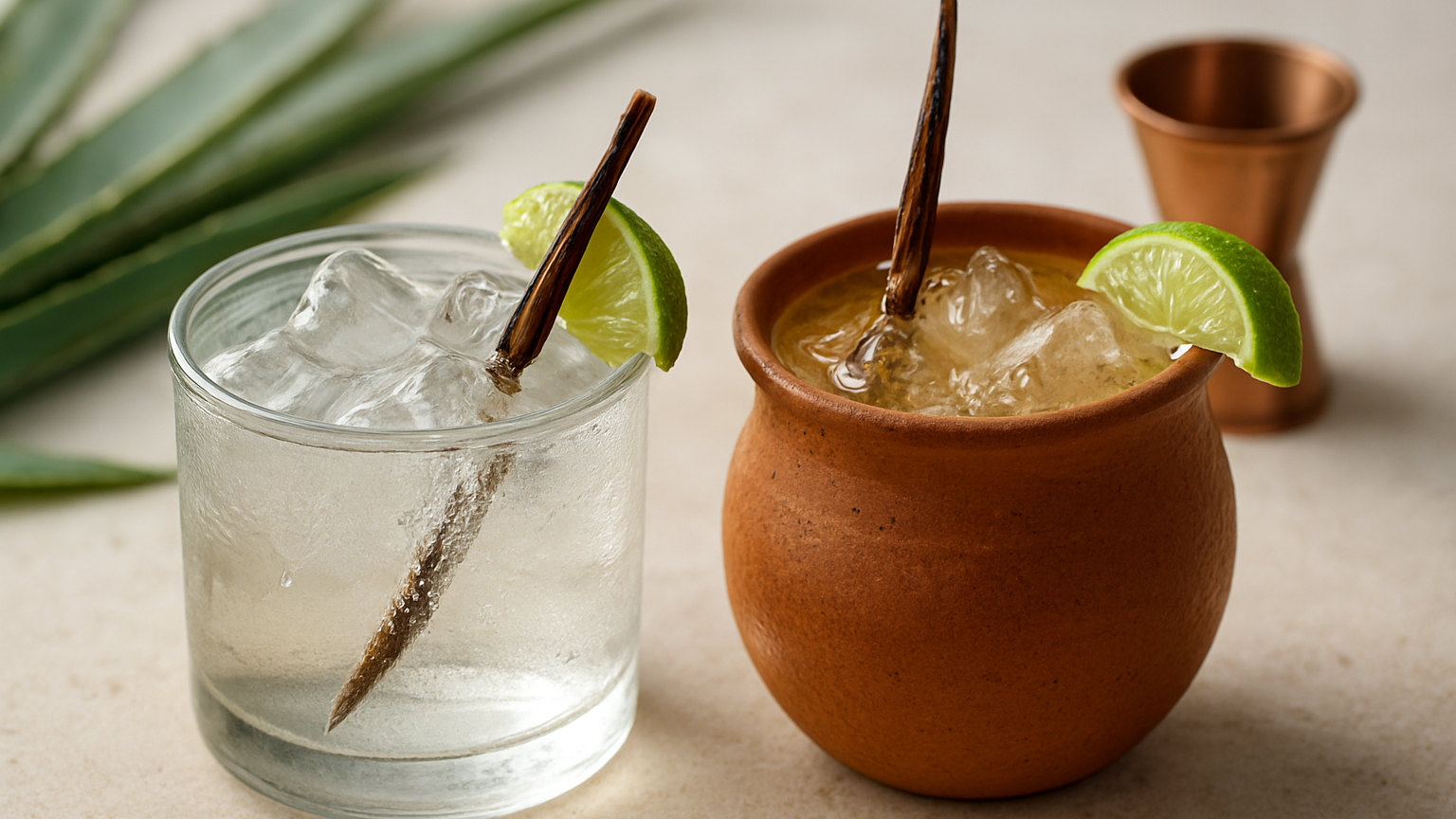
Mezcal is a spirit distilled from cooked agave. By that definition tequila is a mezcal, and historically the word covered every agave spirit in Mexico. Today both are separate protected categories, and the differences run through species, geography and method.
Which agave species are used?
This is the largest difference. Tequila may only use blue Weber agave. Mezcal may use dozens of species, cultivated and wild.
- Espadin accounts for the great majority of mezcal. Cultivated, matures in six to eight years, and gives a balanced and approachable spirit.
- Tobala is a small wild agave growing in shade at altitude, taking twelve years or more, and producing intensely fruity and floral mezcal.
- Tepeztate can take twenty five years to mature and gives herbaceous, vegetal, sometimes startling results.
- Arroqueno, madrecuixe, cuishe, tobaziche and many others each contribute their own character.
Wild species raise a genuine sustainability question, since a plant that takes two decades to mature and is harvested before it flowers cannot reproduce. Producers working with cultivated wild species and leaving plants to flower are addressing this, and it is worth supporting.
Where can mezcal be made?
The denomination covers nine states, with Oaxaca producing the overwhelming majority. Durango, Guerrero, Guanajuato, San Luis Potosi, Zacatecas, Tamaulipas, Michoacan and Puebla are also included.
The two denominations overlap geographically in places, so a producer in certain municipalities could in principle make either, depending on the agave used and the rules followed.
What are the mezcal categories?
Mezcal regulations define three production tiers, which is more useful information than tequila labelling provides.
- Mezcal. The industrial tier. Autoclaves, diffusers, mills and column stills are all permitted.
- Mezcal artesanal. Agave cooked in earthen pits or masonry ovens, crushed by mallet, tahona or mill, fermented in wood, stone, clay or animal hide, and distilled in copper or clay pot stills.
- Mezcal ancestral. The strictest tier. Pit cooking, milling by hand or tahona, fermentation with the fibres, and distillation in clay pots.
Most mezcal worth seeking out is artesanal, and the category name appears on the label.
Why does mezcal taste smoky?
Because the agave is roasted in a pit lined with hot rocks and wood, then covered with agave fibres and earth for several days. Smoke penetrates the plant during that time and survives fermentation and distillation.
Tequila is cooked with steam in ovens or autoclaves, so no smoke is involved. Smokiness is therefore a production marker rather than an inherent quality of agave, and well made mezcal has a great deal more going on than smoke alone.
Is mezcal stronger?
Often, yes. Traditional mezcal is frequently bottled between 45 and 50 per cent, and small producers work to a strength judged by the beading of the spirit rather than to a commercial target. Tequila is usually 38 to 40 per cent.
Higher strength is part of why mezcal reads as more intense, alongside the smoke and the species variation.
What about the worm?
The larva found in some bottles is a marketing device from the mid twentieth century rather than a tradition, and it has never been part of tequila at all. Serious mezcal producers do not use it. Some traditional mezcals are sold with a salt made from the ground larva, which is a genuine local practice and quite different from putting one in the bottle.
Which should you buy?
If you want to understand agave as a plant, buy an espadin mezcal artesanal alongside a blanco tequila and taste them together. The comparison shows exactly what species, pit roasting and traditional production contribute, and it is more instructive than either bottle on its own.
How is mezcal labelled?
Better than tequila, on the whole. Good mezcal labels state the agave species, the village and often the producer by name, along with the production category and the exact bottling strength.
That level of disclosure is normal in the category rather than exceptional, largely because the appeal of artisanal mezcal rests on provenance. When a mezcal label tells you none of these things, that in itself is informative.