Making your own syrups, cordials and infusions is the cheapest way to improve home drinks, and the equipment required is almost entirely things you already own.
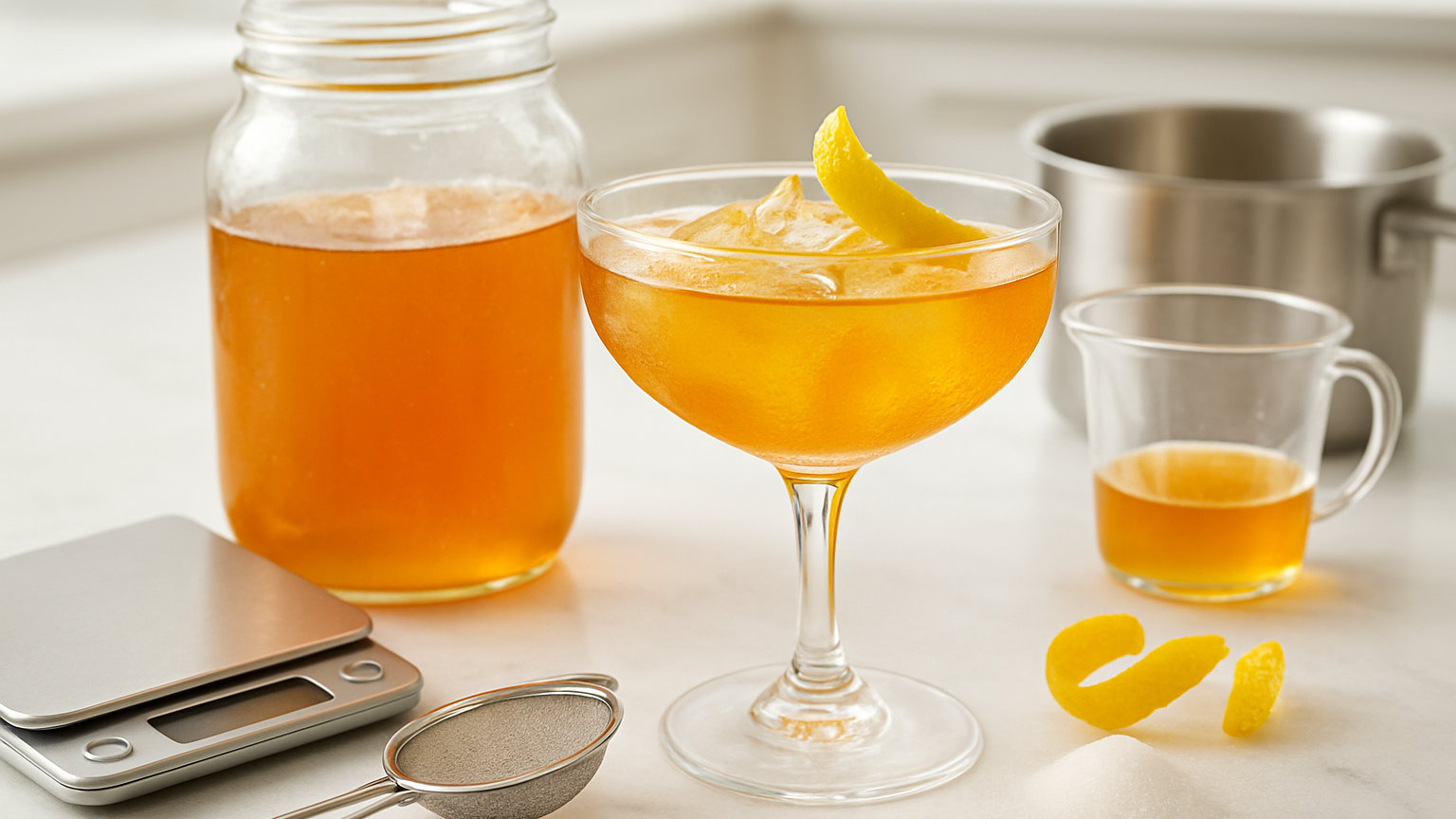
A kitchen scale
The one purchase worth making. Syrups are defined by ratio, and weighing is faster and more accurate than measuring volumes.
A simple syrup is equal weights of sugar and water. A rich syrup is two parts sugar to one of water. Both are trivially easy on a scale and fiddly with jugs.
Digital scales measuring to a gram cost very little and are useful for a great deal beyond drinks.
Jars and containers
Glass jars with sealing lids for infusions. Anything from a jam jar upwards works, and the important thing is that it seals and is glass rather than plastic, which absorbs flavours.
A wide mouth makes filling and straining easier.
For syrups, small bottles that seal properly. Swing-top bottles are convenient and any clean bottle works.
Fill close to the neck, since air in the container is what dulls the contents.
Straining
A fine mesh sieve handles most jobs.
For anything needing a finer filter, muslin or a jelly bag laid in the sieve catches what the mesh does not.
Coffee filters produce the cleanest result and are slow. For a clarified drink or a fat-washed spirit they are the right tool, and the filtering takes hours and cannot be hurried.
A funnel is genuinely useful and prevents most of the mess.
For heated syrups
A small saucepan and a wooden spoon.
Most syrups need no heat at all, since sugar dissolves in cold water with enough stirring, and warm water speeds it up considerably.
Heat is required for anything where you want to extract from a solid ingredient quickly, or where you are reducing.
A thermometer is useful for anything temperature-sensitive and is not necessary for ordinary syrups.
Labels
The most overlooked item on this list.
Masking tape and a pen is sufficient. Write the contents and the date on everything, without exception.
An unlabelled bottle of amber syrup found in three months is either thrown away or used without knowing what it is, and neither is useful.
Note any allergens as well. An infused spirit or a syrup gives no visual clue that it contains nuts, dairy or sesame, and anyone else in the house needs to be able to tell.
Cleanliness and storage
Wash containers thoroughly and rinse completely, since detergent residue will be tasted.
For anything you intend to keep for months, sterilise: rinse with boiling water or heat in a low oven, and dry fully before filling.
Refrigerate everything. A simple syrup keeps around a month, a rich syrup longer since the higher sugar concentration inhibits growth more effectively. Anything containing fresh fruit, herbs or dairy should be used within a week or two.
Discard anything cloudy, fizzing or smelling of fermentation. A syrup that has begun fermenting is spoiling and producing alcohol as it does so.
Optional extras
A sous vide circulator speeds infusions dramatically, producing in an hour what a jar takes days to achieve. Genuinely useful if you already own one and not worth buying for this.
Ice cube trays for freezing syrups in measured portions, which extends the shelf life indefinitely.
A small funnel set, a jam funnel and a jug with a good pouring lip all make the process less messy.
The complete list
Scale, sieve, muslin, funnel, jars, bottles, masking tape and a pen.
Most of that is already in the kitchen, and the whole lot costs less than a bottle of gin.
What to make first
Sugar syrup, which takes five minutes and is used in a great many drinks.
Honey syrup, which is honey thinned with warm water and unlocks the penicillin and several others.
An oleo saccharum from the peel of whatever citrus you are about to juice, which costs nothing and uses something that would otherwise be thrown away.
All three are straightforward, and between them they cover most of what a home bar needs.