Ice is the ingredient most people never think about and the one that determines whether a drink stays balanced or turns to water. The equipment involved is cheap.
Large cube moulds
The single most useful purchase. A silicone mould producing cubes of around five centimetres costs a few pounds.
Large ice has less surface area relative to its volume, so it melts more slowly. A spirit-forward drink over a single large cube stays at its intended strength for far longer than one over small cubes.
Sphere moulds achieve the same thing marginally better, since a sphere has the lowest surface area for a given volume. They are also more awkward to fill and the difference is small.
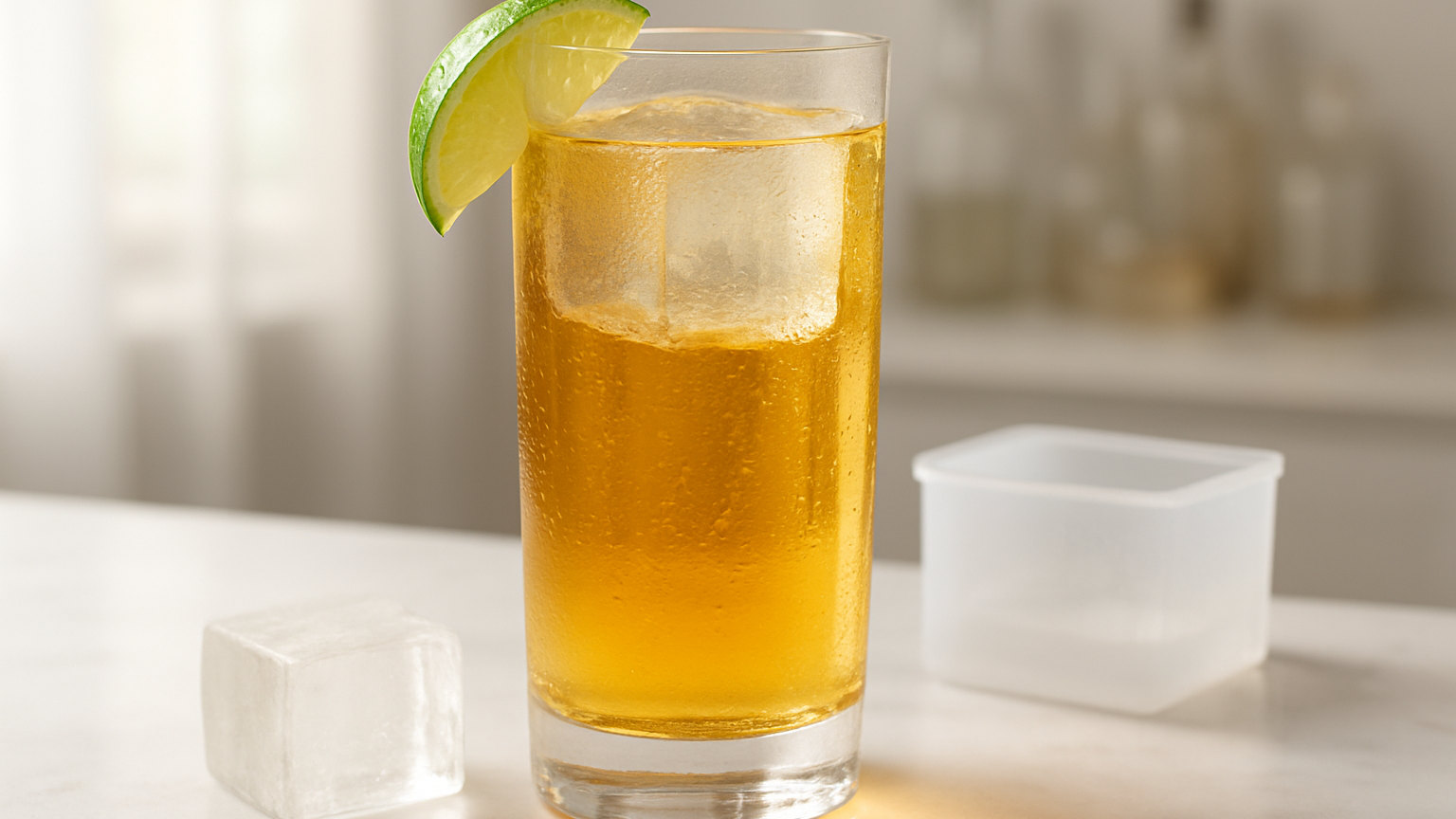
For highballs, standard-sized cubes are fine provided you use enough of them.
Making clear ice
Domestic freezers produce cloudy ice because water freezes from all sides at once, trapping air and impurities in the centre.
Clear ice melts more slowly, since the trapped air creates weak points, and it looks considerably better.
Directional freezing is the home method. Fill an insulated container, such as a small cool box with the lid off, and place it in the freezer. It freezes from the top down, pushing impurities downwards, and the upper portion comes out clear.
Remove it before it freezes solid, or freeze it fully and cut away the cloudy base with a serrated knife.
It takes about a day and produces genuinely clear ice. Whether it is worth the effort is a matter of how much you care.
Crushed ice
Needed for juleps, brambles, cobblers and tiki drinks, where rapid chilling and continuous dilution are part of the design.
A Lewis bag is a canvas bag designed for the purpose, used with a mallet. It absorbs the meltwater, which produces drier crushed ice that packs better.
A clean tea towel and a rolling pin does the same job for nothing.
Food processors and blenders will crush ice and produce inconsistent results and a great deal of slush, and they are hard on the blades.
Storage
Ice absorbs odours, and an open tray in a freezer next to fish or a curry will produce drinks that taste of both.
Store it in a sealed bag or a covered container. This is the most consequential thing on this page and costs nothing.
Old ice also sublimates, shrinking and developing a stale character. Make it fresh rather than leaving a tray for three months.
Use filtered water if your tap water is heavily chlorinated, since the flavour carries through into the glass.
Scoops and tongs
An ice scoop is genuinely useful and cheap. Using a glass to scoop ice is how glasses get chipped, and a chipped rim is both unpleasant and a hazard.
Tongs are for placing single large cubes and are otherwise unnecessary.
Never use hands, which is a hygiene point rather than a fussy one.
For a party
Buy ice rather than making it. A domestic freezer cannot produce enough for more than a handful of people, and bagged ice is inexpensive.
Plan on roughly a kilogram per person for an evening, more in warm weather.
A cool box or an insulated container keeps it frozen far longer than a bowl on a table.
What to buy first
A silicone mould for large cubes, a bag to store ice in, and a scoop.
That is under ten pounds and improves every drink you make more than any bottle at the same price.
Cutting large ice
For anyone making clear ice in a block, a serrated bread knife and a mallet will cut it into cubes.
Score a line with the knife, then tap along it. The ice splits along the score.
Work with cold hands and a cold surface, and let the block temper for a few minutes out of the freezer first, since ice straight from a very cold freezer is brittle and shatters unpredictably.
Filtered or tap
Heavily chlorinated tap water carries through into the glass, and a jug filter removes most of it.
In soft water areas it makes very little difference, and it is worth tasting your own tap water cold before deciding it matters.