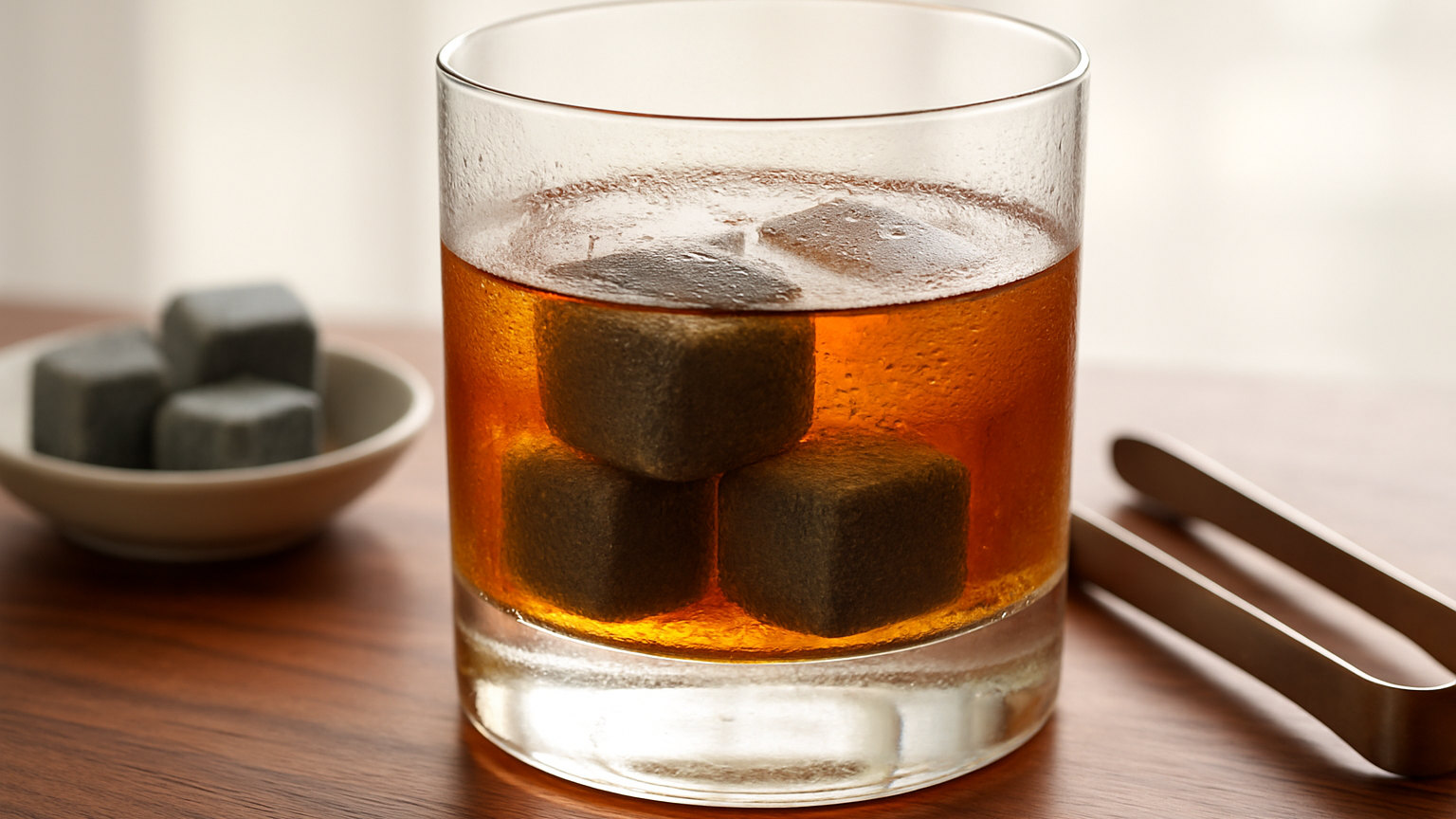
Whisky stones, usually soapstone or stainless steel, are frozen and dropped into a drink to chill it without adding water. They are a popular gift and they do not work well, for a reason that is worth understanding.
Why ice cools so effectively
Melting requires a great deal of energy.
Changing ice at zero degrees into water at zero degrees absorbs far more energy than warming the same mass of water by several degrees does. That energy comes out of the drink, which is why ice chills so powerfully.
A solid that does not melt cannot access that mechanism. All it can do is warm up, absorbing the comparatively small amount of energy required to raise its own temperature.
The consequence
A few frozen stones in a glass of spirit will lower the temperature by a small number of degrees at most, and the effect fades within minutes as the stones reach equilibrium.
The same mass of ice would chill the drink substantially further and hold it there while it melted.
Comparisons are consistently unflattering: stones produce a drink that is barely cooler than one served neat, while ice produces one that is genuinely cold.
The other problem
The premise assumes dilution is undesirable, which is frequently wrong.
A small amount of water in a whisky lowers the alcohol content enough to release compounds that were bound up in the ethanol, and the aroma frequently opens up substantially.
Many distillers and blenders taste with water added for exactly this reason.
So the problem the stones solve is not always a problem, and the solution does not work anyway.
What works instead
If you want a spirit cold with minimal dilution, chill the bottle and chill the glass.
A bottle kept in the freezer pours at around minus eighteen degrees and needs no ice at all. This suits vodka, gin and aquavit particularly well.
A chilled glass keeps it there.
For whisky, a single large clear cube is the standard answer: it chills genuinely and dilutes slowly, and by the time it has added noticeable water the drink has usually been finished.
Freezing a small quantity of the spirit itself into cubes is another approach, though a spirit at forty per cent will not freeze solid in a domestic freezer.
Where stones have a use
Two narrow ones.
For a cask strength spirit that you want slightly cooler without any dilution at all, stones do something, though very little.
And as an object, they are pleasant and look considered, which is a legitimate reason for a gift even if the function is minimal.
Related products
Stainless steel cubes filled with a gel perform slightly better than solid stone, since the gel undergoes a phase change and therefore absorbs more energy. The effect is still far below ice.
Chilled metal rods and similar devices work on the same principle with the same limitation.
Plastic cubes filled with water are effectively ice in a container: they perform reasonably and are awkward to clean, and ordinary ice is simpler.
The honest summary
If you want a drink cold, use ice or chill the bottle.
If you object to dilution specifically, try the drink with a few drops of water before assuming dilution is the enemy.
And if someone gives you whisky stones, they are perfectly pleasant to use and the effect is largely ceremonial, which is fine as long as it is understood as such.
Cleaning them
If you do use them, wash and dry them thoroughly between uses and store them in a sealed container in the freezer.
Soapstone is porous and can hold flavours and odours, so a set used with whisky and then with gin will carry something across.
Steel is easier to clean and picks up freezer smells if stored uncovered, exactly as ice does.
The alternative gift
A large-cube silicone mould costs less and genuinely improves a drink, which makes it a better present for anyone who drinks spirits.