Bitters are a concentrated blend of aromatic and bittering botanicals extracted into alcohol. Making them is entirely possible and is a project rather than an afternoon, and it starts with a question about ingredients.
Safety first
This matters more here than anywhere else in home drinks making.
A number of plants traditionally used as bittering agents are not safe to consume in quantity, and some are not safe at all. Historical recipes are not a reliable guide, since they were written when the risks were poorly understood.
Buy dried botanicals from a supplier that sells them as food or as culinary ingredients, with clear labelling. Herbal suppliers, brewing suppliers and specialist food shops all stock them.
Do not forage for bittering plants unless you are genuinely certain of the identification and of the safety, which is a higher bar than it sounds. Several toxic plants closely resemble edible ones.
Wormwood, which appears in a great many traditional recipes, contains a compound subject to legal limits in food and drink in the United Kingdom and elsewhere. Use culinary-grade material at the quantities recipes specify rather than improvising.
Anyone taking medication or with a health condition should be aware that concentrated botanical extracts can interact with medicines, and a doctor or pharmacist is the right person to ask.
The structure
Bitters have two components: bittering agents and aromatics.
Bittering agents provide the backbone. Gentian root is the most common and the most useful. Cinchona bark, dandelion root, burdock root and quassia all appear.
Aromatics provide the character: citrus peel, cinnamon, cardamom, clove, allspice, star anise, coriander seed, ginger, vanilla and a great many others.
The bittering agents are used in far smaller quantities than the aromatics, and the balance between them is what distinguishes one recipe from another.
Why separate infusions
The approach that produces a good result.
Different botanicals extract at different rates. Citrus peel gives up its aroma in a day; a hard root takes weeks. Infusing everything together means some ingredients are over-extracted before others have started.
So each botanical is infused separately in high-strength alcohol, strained when ready, and the finished tinctures are blended.
That also lets you adjust the blend by tasting rather than committing to a recipe, which is the only realistic way to arrive at something you like.
The method
Infuse each botanical separately in a small jar with a high-strength neutral spirit, ideally fifty per cent or above.
Leave them somewhere dark, shaking occasionally, tasting periodically.
Strain each when it reaches the intensity you want, through a fine sieve and then a coffee filter.
Then blend, drop by drop, tasting as you go. Start with the aromatics and add the bittering tinctures sparingly, since a small amount goes a very long way.
Some recipes add a small quantity of rich syrup at the end to round the result.
Let the blend rest for a week or two before judging it, since the components integrate over time.
The time involved
Realistically a month or more from starting to having something usable.
Individual infusions take days to weeks. Blending and adjusting takes several sessions. Resting takes a fortnight.
It is a genuinely enjoyable project and it is not a way of saving money, since a bottle of commercial bitters costs very little and lasts for years.
Storage and labelling
Bitters keep indefinitely thanks to the alcohol content.
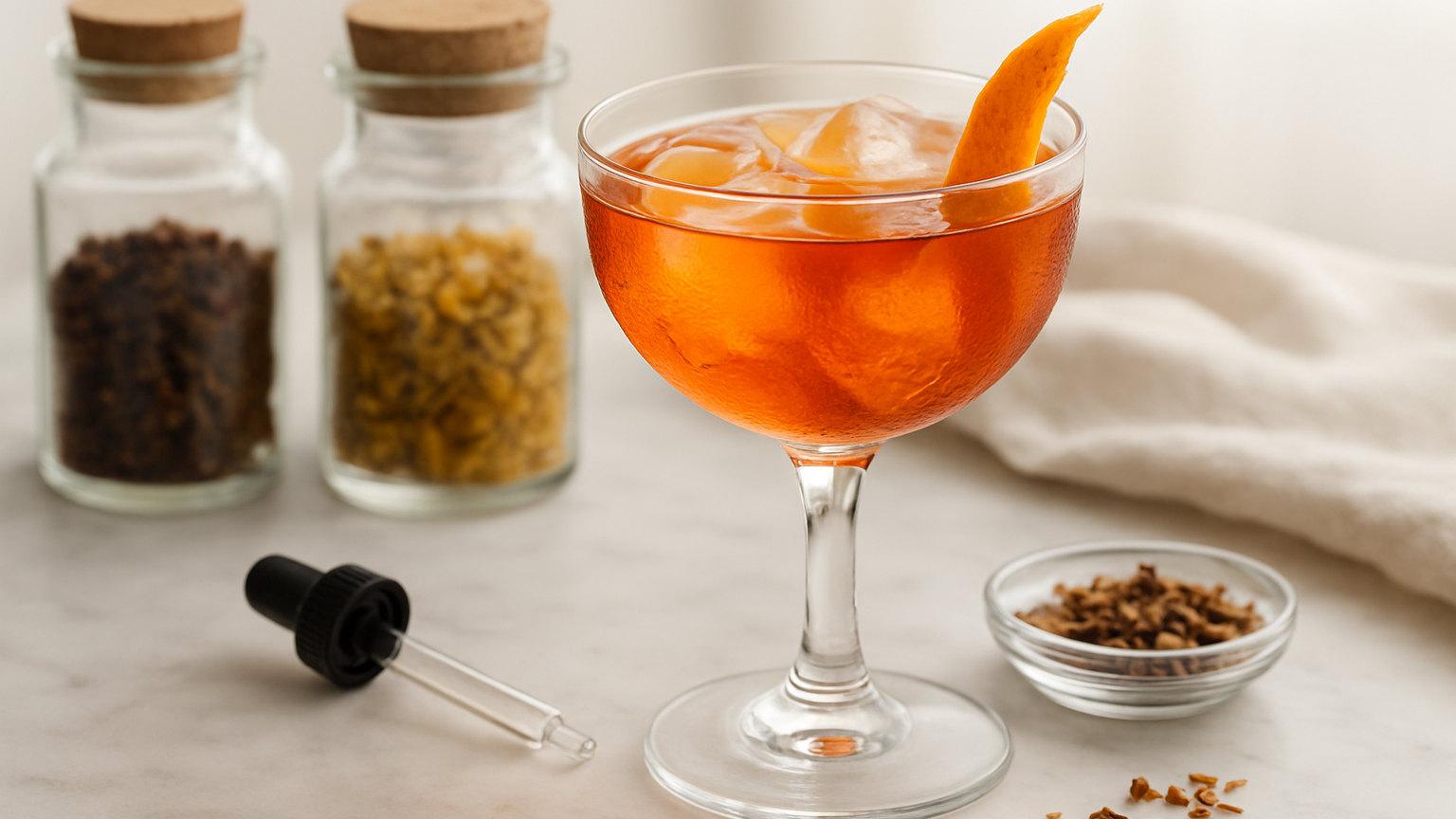
Store in dark dropper bottles away from light.
Label everything, including the individual tinctures, with the botanical and the date. A row of unmarked dark bottles is both useless and a hazard.
Whether to bother
For most people, no. Commercial bitters are inexpensive, excellent and last for years, and three bottles cover almost every recipe.
For anyone who enjoys the process and wants something specific that is not made commercially, it is a rewarding project with a long lead time.
Starting with a single-botanical tincture, which is a much smaller commitment, is the sensible way to find out whether the larger project appeals.
Reading around it
Several books cover the subject properly, with tested recipes and sourcing advice, and they are a better starting point than a recipe found without context.
Look for ones that discuss which botanicals to use and in what quantities, rather than ones that assume the reader already knows.