Sugar syrup is the most used ingredient in cocktails after the spirits themselves, and it is sugar dissolved in water. Buying it is one of the least sensible purchases in drinking, since making it takes five minutes and costs pennies.
Why syrup rather than sugar
Granulated sugar dissolves poorly in cold liquid, particularly in something alcoholic and already chilled.
A drink made with sugar rather than syrup ends up with crystals in the bottom of the glass and a balance that shifts as they gradually dissolve.
Syrup incorporates immediately and can be measured accurately, which matters when the difference between a balanced sour and a sharp one is a few millilitres.
Simple syrup
Equal weights of sugar and water, which is usually written as one to one.
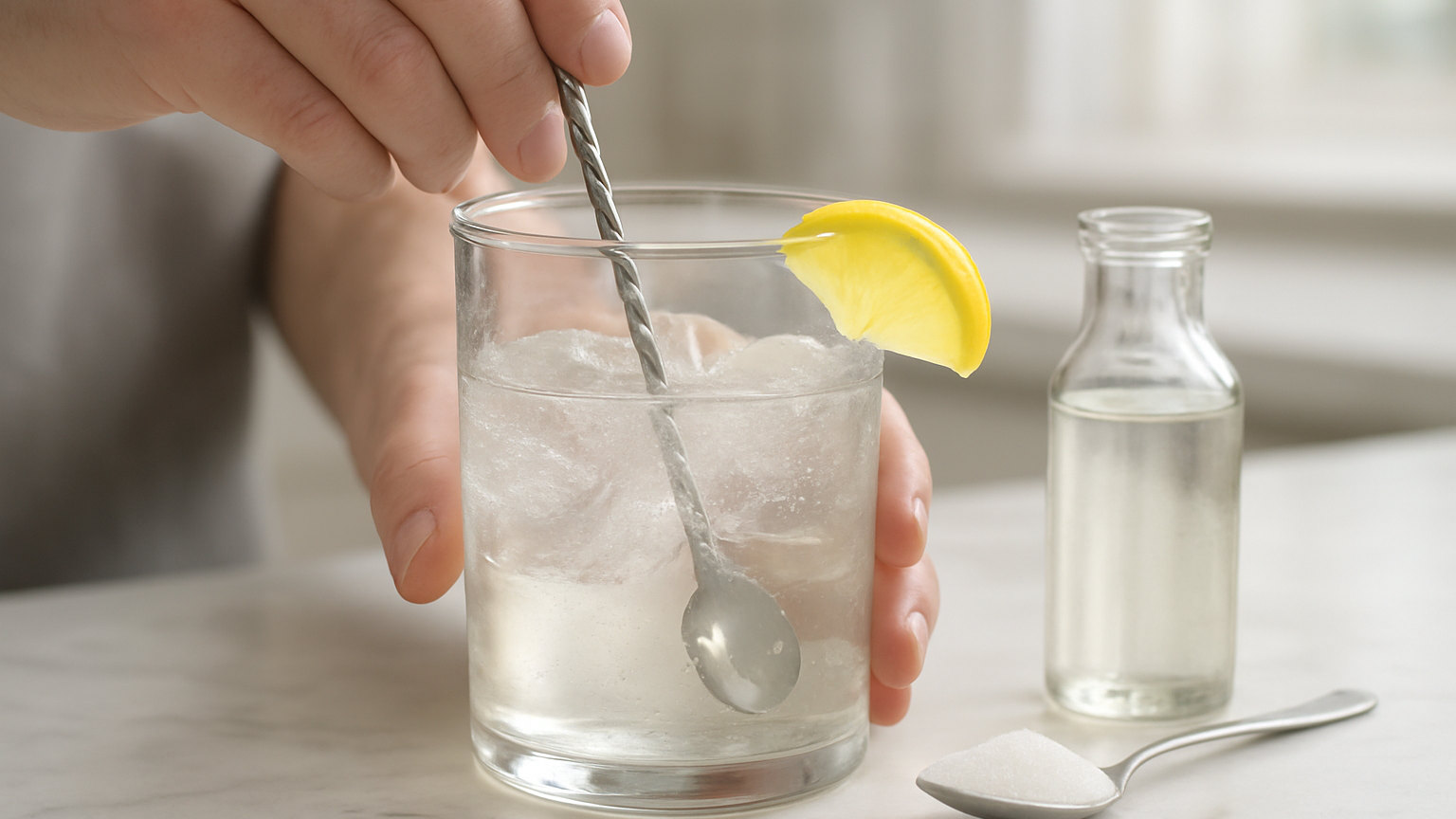
Combine 200 grams of caster sugar with 200 grams of water and stir until dissolved. Warm water speeds it up considerably and no heating is necessary.
Weighing is faster and more accurate than measuring by volume, since sugar packs unpredictably in a jug.
This is the default for most recipes, and a recipe calling for syrup without qualification means this.
Rich syrup
Two parts sugar to one part water by weight, which is thicker and roughly twice as sweet.
Combine 400 grams of sugar with 200 grams of water. This needs gentle warming, since that quantity of sugar will not dissolve readily in cold water.
The advantages are real. A smaller measure achieves the same sweetness, which means less dilution in the finished drink. It adds noticeably more body. And it keeps considerably longer, since the higher sugar concentration inhibits microbial growth.
Where a recipe calls for 20 millilitres of simple syrup, around 12 to 15 of rich syrup is roughly equivalent, and it is worth tasting rather than assuming.
Whether to heat it
For a one to one syrup, no. Stirring in warm water dissolves it perfectly well within a couple of minutes.
Heating drives off water through evaporation, which changes the ratio unpredictably, and it offers no benefit for a plain syrup.
For a rich syrup, gentle warming is the practical way to get that much sugar into solution. Warm rather than boil, and take it off the heat as soon as it is clear.
Heat is genuinely useful only when you are extracting flavour from a solid ingredient, which is a different exercise.
Gum syrup
The traditional bar version, worth knowing about.
Gomme syrup is sugar syrup with gum arabic dissolved in it, which adds a silky viscosity that sugar alone cannot produce.
It was standard in nineteenth century bartending, fell out of use and has been revived. It can be bought ready-made, or produced at home by dissolving gum arabic powder in warm water and combining it with syrup, which takes patience since the gum dissolves slowly.
A small quantity transforms a thin drink, and it is particularly useful in anything low in alcohol where body is otherwise lacking.
Storage
Refrigerate in a clean sealed bottle, filled close to the neck.
A one to one syrup keeps around a month. A two to one syrup keeps considerably longer, often several months, since the sugar concentration is high enough to inhibit growth.
Adding a small measure of a neutral spirit, around 30 millilitres per litre, extends the life of a one to one syrup noticeably.
Label with the contents and the date.
Discard anything cloudy, fizzing or smelling of fermentation, since a syrup that has started fermenting is spoiling.
Quantities to make
Make what you will use within a month rather than a large batch that goes off.
For most households, 200 grams of sugar producing around 350 millilitres of syrup is plenty, and it takes as long to make as a smaller quantity.
Freezing syrup in an ice cube tray gives measured portions that keep for months, which is worth doing for anything you use occasionally.
Substituting between ratios
Where a recipe specifies one and you have the other, the arithmetic is straightforward enough.
Rich syrup is roughly twice as sweet by volume, so use around half to two thirds as much, then taste. The drink will also be slightly less diluted, which is usually an improvement.