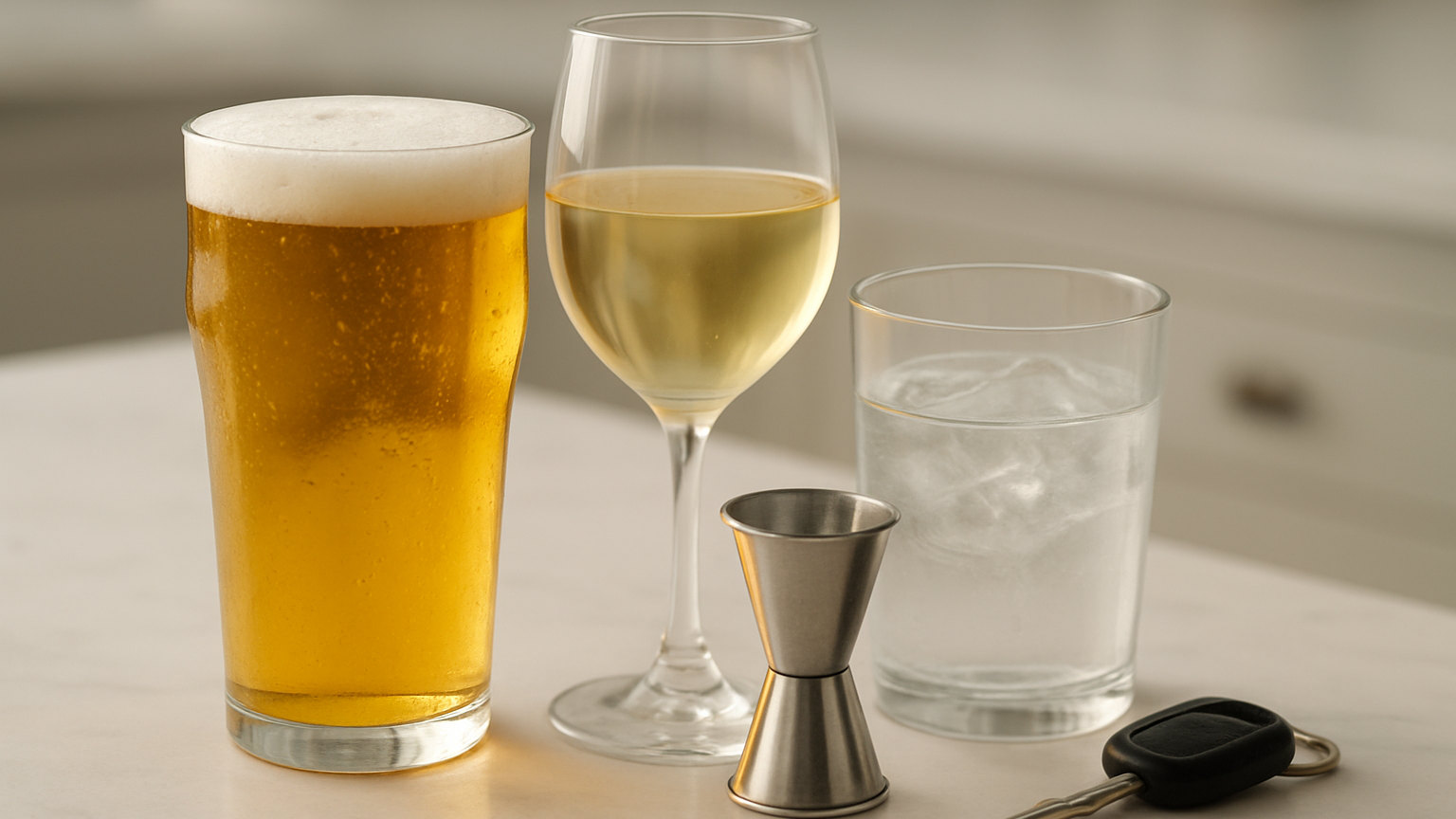
People routinely try to work out how many drinks they can have and still drive. There is no reliable way to do that, and this article does not provide one, because any figure would be wrong for some people on some occasions.
Why the arithmetic does not work
Blood alcohol concentration depends on a considerable number of variables.
Body weight and composition, since alcohol distributes through body water and people differ substantially in how much they have.
Sex, since average body composition differs and so does the activity of the enzymes involved.
Whether you have eaten, and what, since food slows absorption considerably.
How quickly you drank, since absorption and elimination happen simultaneously and the balance between them matters.
Age, general health, liver function and medication, all of which affect how alcohol is processed.
And individual variation that is not predictable from any of the above.
The result is that two people of similar size drinking the same thing over the same period can end up at meaningfully different levels.
The limits are not uniform
England, Wales and Northern Ireland have one limit. Scotland has a lower one, having reduced it in 2014.
The limits are expressed in milligrammes of alcohol per hundred millilitres of blood, with equivalent figures for breath and urine.
Anyone driving across the border should be aware the figure changes, and limits differ again across Europe and elsewhere.
Current figures should be checked with an official source rather than taken from any article, since they can change.
The morning after
The risk most often overlooked and a common cause of prosecutions.
Alcohol leaves the body at a broadly constant rate that cannot be accelerated. Coffee, food, a shower and sleep do not speed it up.
Someone who drinks heavily late into the evening may still be over the limit the following morning, and may feel entirely capable while being legally impaired.
The sensation of having slept it off is not a reliable indicator of anything.
Why feeling fine is not evidence
Alcohol impairs judgement, including the judgement required to assess whether you are impaired.
Reaction time, hazard perception, coordination and decision-making are all affected at levels below the legal limit, which is why the guidance from road safety organisations is more cautious than the law.
The legal limit is a threshold for prosecution rather than a level at which driving is unaffected.
Breathalysers
Personal breathalysers are sold and vary considerably in accuracy.
They are not a substitute for not drinking, and treating a reading as permission to drive is a poor use of a device with a margin of error.
Police equipment is calibrated and evidential; a consumer device is not.
The only reliable approach
If you are driving, do not drink.
That is the advice given by road safety organisations, by the police and by every source that is not trying to sell something, and it is the only position that does not depend on variables you cannot measure.
If you have been drinking, plan not to drive, including the following morning if it was a late or heavy evening.
Practical arrangements
Decide before going out rather than during the evening, since the decision gets worse as the evening goes on.
Agree a designated driver who is not drinking at all rather than drinking less.
Have the number of a taxi firm, or an app installed, before you need it.
If you host, provide genuinely good non-alcoholic options and do not press drinks on anyone who has said they are driving.
And if you are unsure the following morning, do not drive. There is no version of that decision where being wrong is a small problem.
Where to check
Current limits, penalties and guidance are published by the government and by road safety charities, and those are the appropriate sources.
Anyone with questions about alcohol and a medical condition or medication should speak to a doctor or pharmacist.
If you are hosting
Ask early who is driving and make sure there is something genuinely good for them to drink.
Do not top up glasses without asking, since it makes it impossible for anyone to keep track of what they have had.